Selecting maintenance management software for real-time asset tracking and technician workflows often stalls when platforms demand custom integration before deployment. Many systems require direct sales inquiry for pricing, which slows procurement for plant supervisors and operations managers. This comparison covers features, rollout speed, and integration support across five tools so operations teams can match software to their site needs without delay.
Table of Contents
- Gemba Labs
- UpKeep Asset Operations Management Platform
- Fabrico.io
- Fiix CMMS
- eMaint
- Comparison of alternatives
Gemba Labs
At a Glance
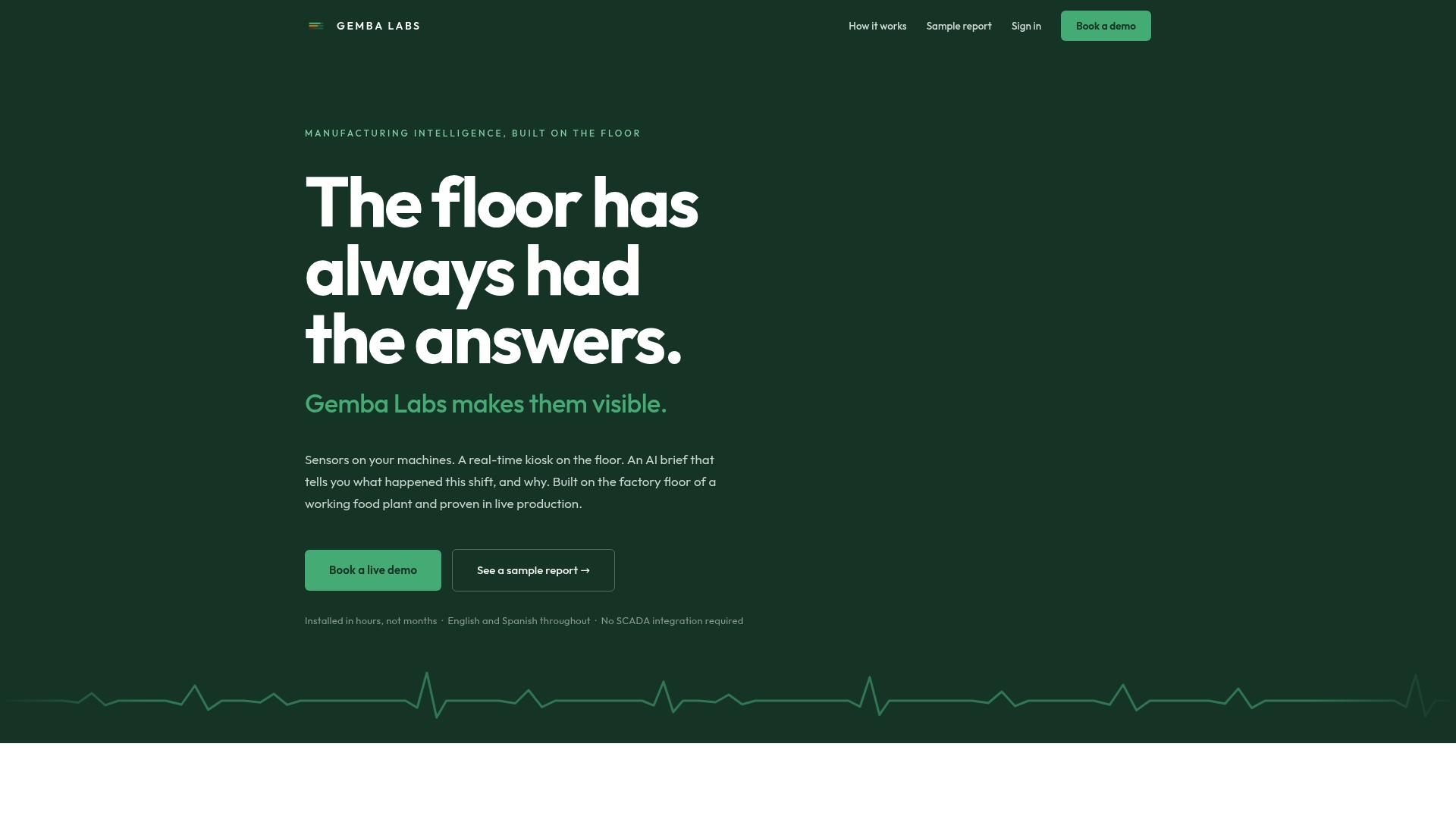
A live performance scoreboard updates every 60 seconds on the factory floor. Gemba Labs captures machine cycle data with equipment sensors and pairs it with operator notes for context. The system runs live at a food plant in West Michigan, so it reports shift-level results and early warnings.
Core Features
Gemba Labs installs sensors on equipment to collect real-time cycle and downtime data, and it layers AI to analyze downtime, SKU performance, and shift outcomes. The platform displays a live performance scoreboard and ingests operator notes to provide ground truth and context. Pattern recognition builds institutional memory so recurring problems surface automatically over time.
Key Differentiator
Rapid deployment and no SCADA requirement set Gemba Labs apart. The product delivers real-time, AI-driven insights directly on the factory floor without a heavy systems integration project. That combination lets plants start seeing shift-level reports and early warnings with minimal installation time.
Pros
The vendor advertises rapid deployment in hours rather than months. That timeline claim matters for small plants that cannot afford long integration windows. Gemba Labs avoids SCADA dependence, which reduces engineering overhead and speeds rollout. Built-in bilingual support in English and Spanish lowers training friction for mixed-language crews. The platform’s pattern recognition moves recurring issues into the plant’s memory, which reduces repeat troubleshooting across shifts.
Cons
- May not suit large enterprises that require deep MES or SCADA integration and extensive customization.
Who It's For
Operations managers and plant supervisors at small to mid-sized food manufacturers who need fast, on-floor visibility will find this useful. Use cases include teams with limited integration budgets and those that need bilingual operator workflows. It fits plants that want actionable shift reports without a lengthy IT project.
Unique Value Proposition
Pattern recognition that records recurring faults and operator responses creates a durable institutional memory. That memory reduces time spent re-diagnosing the same failures and speeds corrective actions across shifts. For plants with mixed-language crews, the bilingual capture of notes preserves context that typically gets lost in handover.
Real World Use Case
A food manufacturer fitted Gemba Labs sensors on two production lines and began receiving real-time performance data and shift reports. Operators saw early warnings, management reviewed shift-level summaries, and the site resolved recurring issues faster over several weeks. The combined sensor plus note provenance clarified root causes.
Pricing
No explicit pricing is listed. The product data labels pricing as not applicable for informational only, so interested buyers must contact the vendor for a quote.
Website: https://gembalabs.io
UpKeep Asset Operations Management Platform
At a Glance
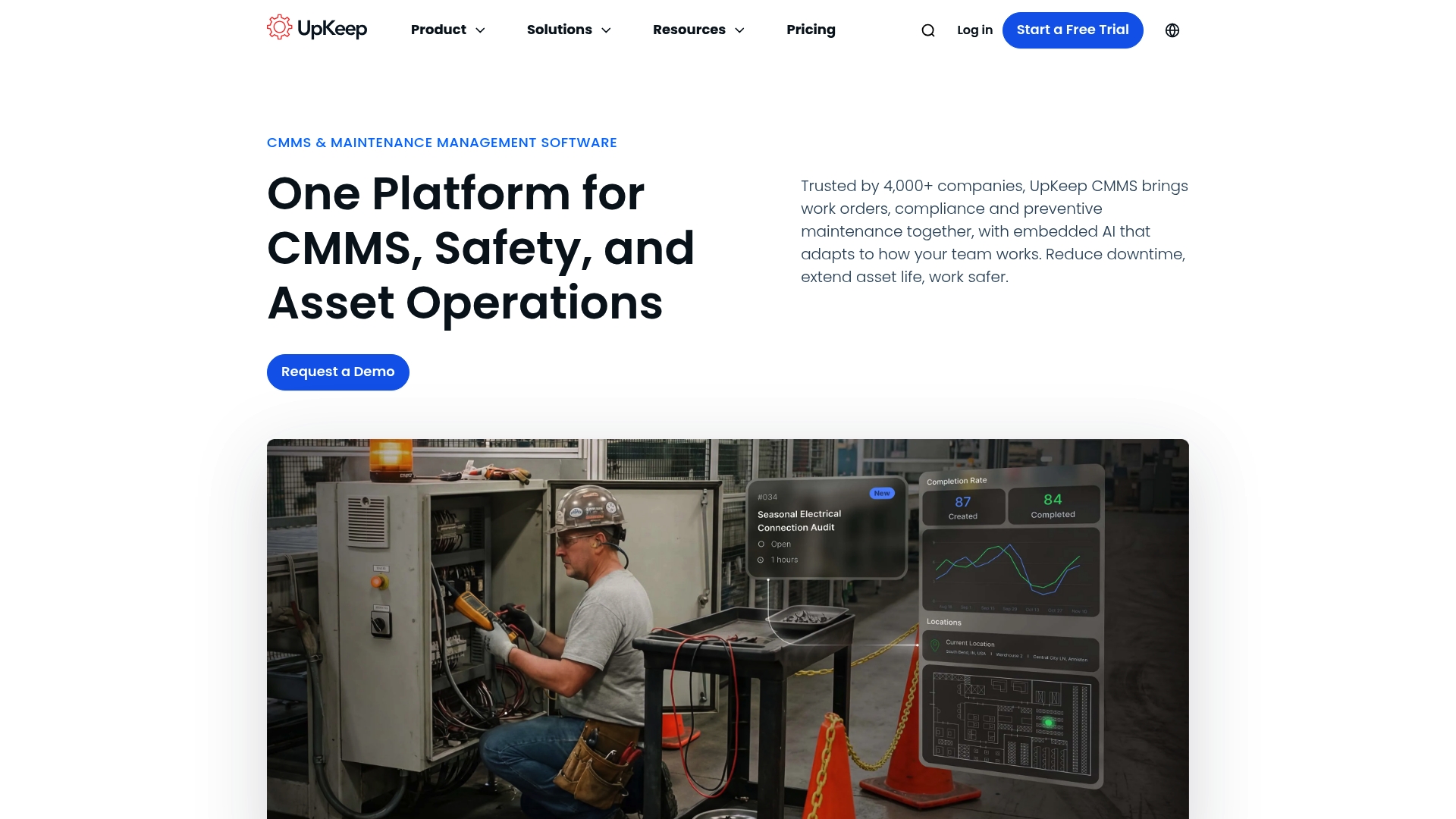
UpKeep reports more than 4,000 customer companies worldwide. The platform combines work order management, preventive maintenance scheduling, safety tracking, and IoT sensors in one system. Mobile access and support for multiple sites give technicians and managers on-the-floor visibility and task control.
Core Features
Work order management with mobile access and preventive maintenance scheduling handles technician workflows and recurring tasks across sites. The platform includes AI automation called Nova that can trigger routine actions and an IoT module called Edge for real-time asset monitoring. Safety and compliance tracking ties inspection records to assets and generates audit-friendly reports for regulated facilities.
Key Differentiator
Embedded AI plus native IoT connectivity lets teams move from reactive fixes to event driven maintenance. That integration links sensor alerts to automated work orders and maintenance windows. For facilities with many machines or distributed sites, that reduces the gap between anomaly detection and technician response.
Pros
A clear mobile interface helps technicians receive, update, and close work orders while on site. Deep integration options let maintenance teams connect asset records to ERP systems and sensor networks for synchronized data. Multiple features cover the asset lifecycle from preventive schedules to safety checks, and AI automation reduces repetitive manual steps for common failure modes.
Cons
- Pricing details for advanced plans require contacting sales, which can slow procurement for small teams.
- The platform has many modules, so setup and initial training can take weeks for complex enterprise deployments.
- Smaller single site operations may find the feature set larger than they need and harder to justify financially.
When It May Not Fit
If your operation has a single building with a handful of machines, the deployment effort may outweigh the operational benefit. Organizations with minimal integration needs will pay for capabilities they will not use. Groups without internal change management resources should plan for vendor or third party onboarding support.
Notable Integrations
- ERP systems
- Sensor networks
- IoT platforms
- Custom API integrations
These connections let asset events flow into existing enterprise records and let sensor data create automated maintenance actions.
Who It's For
Maintenance and reliability managers at medium to large enterprises who manage assets across multiple sites will get the most value. Teams that already use ERP systems or sensor networks will benefit from the integration options. Organizations aiming to reduce unplanned downtime through automated alerts and scheduled work orders are a strong fit.
Real World Use Case
A manufacturing firm with more than 200 assets across several locations uses UpKeep to automate work orders and schedule preventive maintenance. IoT sensors feed real-time status into the platform and trigger inspections when thresholds cross. That setup shortens technician response time and helps extend equipment life.
Pricing
Pricing starts at $24 per user per month for the Essential plan. Higher tiers add features for larger organizations and enterprise needs. Custom quotes are available for advanced deployments and multi site licensing.
Website: https://upkeep.com
Fabrico.io

At a Glance
According to the company, one customer reduced downtime by 20% after deploying Fabrico. The platform combines MES, OEE, and CMMS with computer vision and AI to give operations visibility across multiple sites. Fabrico targets complex factories such as aerospace, automotive, pharma, and FMCG where legacy machines and multiple plants create blind spots.
Core Features
Fabrico delivers MES & OEE modules that capture real time production metrics and visualize cycle performance across lines. Its CMMS covers maintenance planning, job execution, and asset tracking while computer vision validates quality and confirms downtime events. Machine connectivity uses PLCs, IoT sensors, or AI driven cameras and AI add ons offer diagnostics and process improvement suggestions.
Key Differentiator
Fabrico ties camera based vision with AI analytics directly into execution and maintenance workflows. That link turns visual evidence into maintenance tickets and production alerts without manual translation. The result is visibility that spans both human and machine causes of stoppages.
Pros
Fabrico pairs mobile and web apps for quick operator access and straightforward onboarding. Its combined production and maintenance toolset reduces the need for separate dashboards and simplifies root cause analysis. Customer support and the vendor reported rapid deployment help shorten time to useful data in multi site environments.
Cons
- The extensive feature set may require thorough user training to unlock its full value.
- Upfront investment and integration complexity can be significant for large scale rollouts.
- Pricing plans vary by plant and user and may become costly for very large deployments.
When It May Not Fit
If your shop runs a single small line with no legacy PLCs, the platform may be heavier than needed. Organizations with limited IT or OT integration resources will face longer setup timelines. Buyers seeking a plug and play asset tracker without systems integration should look elsewhere.
Who It's For
Fabrico suits manufacturing enterprises pursuing digital operations across multiple sites and complex asset estates. It fits plants that must connect legacy equipment to modern dashboards and want combined production and maintenance visibility. The product works best where teams can commit to initial integration and operator training.
Real World Use Case
A multinational automotive parts manufacturer used Fabrico to link legacy machines, monitor production in real time, and run predictive maintenance. The vendor reports that same 20% downtime reduction for that deployment. That outcome translated into measurable uptime gains and lower emergency maintenance costs.
Pricing
Pricing is per user and per plant with tiered plans. Small plants may qualify for a free tier while enterprise customers receive custom quotes for broader site coverage and advanced AI modules.
Website: https://fabrico.io
Fiix CMMS
At a Glance
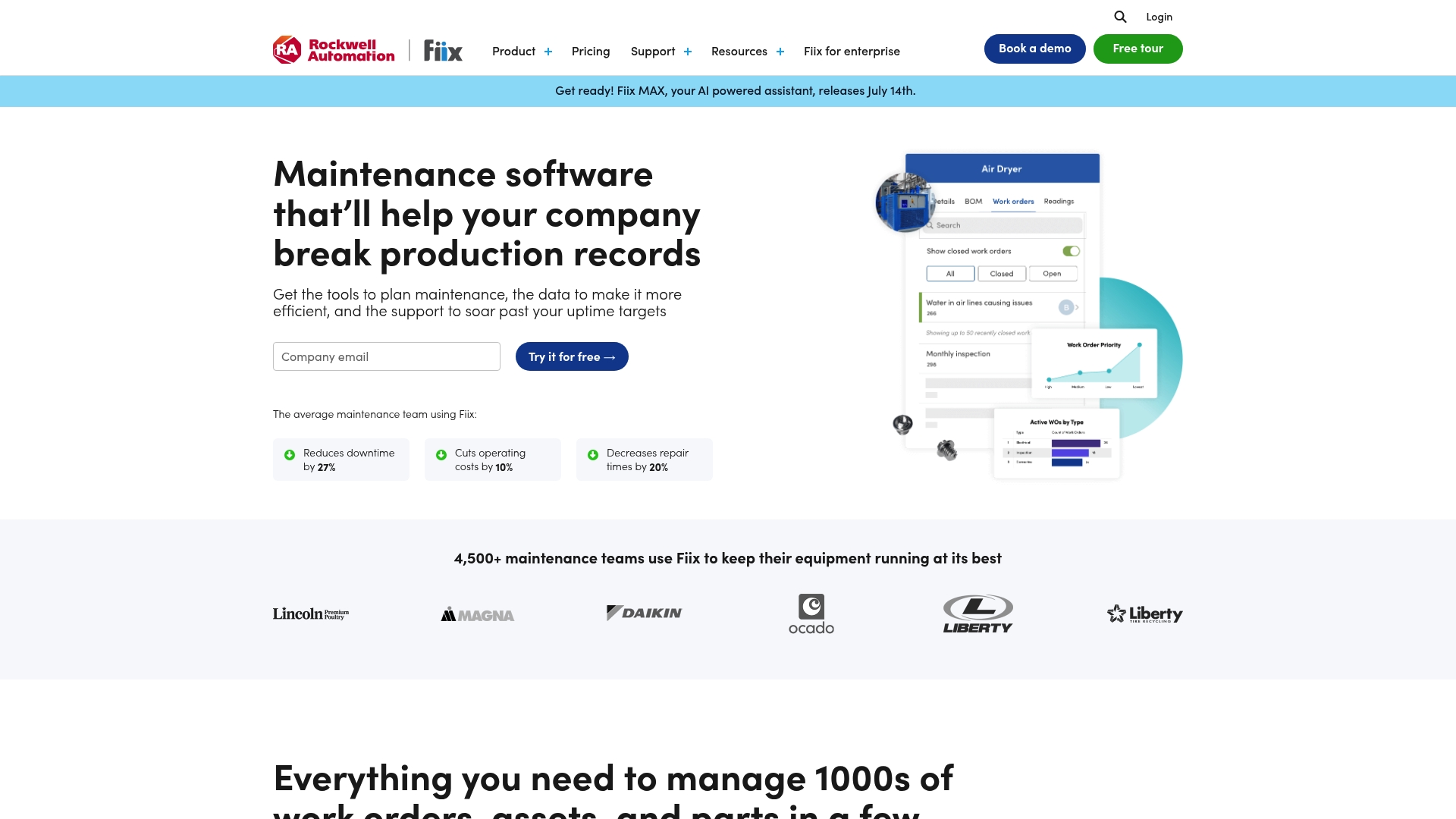
According to the company, Fiix Foresight ties inventory forecasting directly to work order demand to reduce parts stockouts. The product targets manufacturing, oil and gas, and food and beverage operations. It pairs traditional CMMS functions with AI features and IoT integrations for real-time data.
Core Features
Fiix includes asset management to track and control equipment performance, and work order management to create, schedule, and record maintenance tasks. The platform also supports parts and supplies management with inventory forecasting, plus analytics and reporting for data-driven decisions. Integrations let you connect Fiix to industrial systems and IoT devices for live condition monitoring.
Key Differentiator
Fiix’s primary advantage is an open platform strategy that prioritizes third-party integrations alongside AI tools for predictive maintenance. That combination aims to let analytics, sensor data, and maintenance workflows share a single source of truth. Teams that need to combine plant systems with maintenance data will find that integration focus valuable.
Pros
The vendor positions Fiix as a modern, open platform with broad third-party integration support and partner-focused deployment. It highlights AI features for predictive maintenance and inventory forecasting, which help prioritize work and reduce emergency repairs. Security gets attention too, with SOC 2 Type 2 compliance and AWS hosting listed. The vendor reports positive user reviews that cite improved uptime, higher efficiency, and reduced maintenance costs.
Cons
- Setup complexity can increase for large or highly customized deployments. Advanced integrations require technical skill and development work.
- Pricing requires direct inquiry, which can slow procurement and may put small operations at a disadvantage.
- The feature set is extensive and may overwhelm smaller teams new to computerized maintenance management.
When It May Not Fit
If you run a single-site shop with limited IT support, Fiix may feel overly complex and costly. Organizations that need a quick, low-cost starter CMMS could find the implementation effort too high. Teams without integration requirements might not use the open platform benefits enough to justify the price.
Who It’s For
Fiix fits maintenance managers and enterprise facility teams in manufacturing, oil and gas, and food production seeking scalable CMMS capabilities. You should have some IT resources or integration needs to benefit from the open platform. Medium to large organizations that plan predictive maintenance programs will get the most value.
Real World Use Case
A manufacturing facility ties machine sensors to Fiix so technicians see live condition alerts inside work orders. Planners use that data plus Fiix Foresight to forecast spare parts demand before shortages occur. The result reduces unplanned downtime and trims inventory carrying costs.
Pricing
Pricing is available upon request and is quoted based on customer needs and deployment scope. Plans likely vary by user count, modules, and integration complexity. Contact Fiix for a tailored quote and implementation estimate.
Website: https://fiixsoftware.com
eMaint
At a Glance
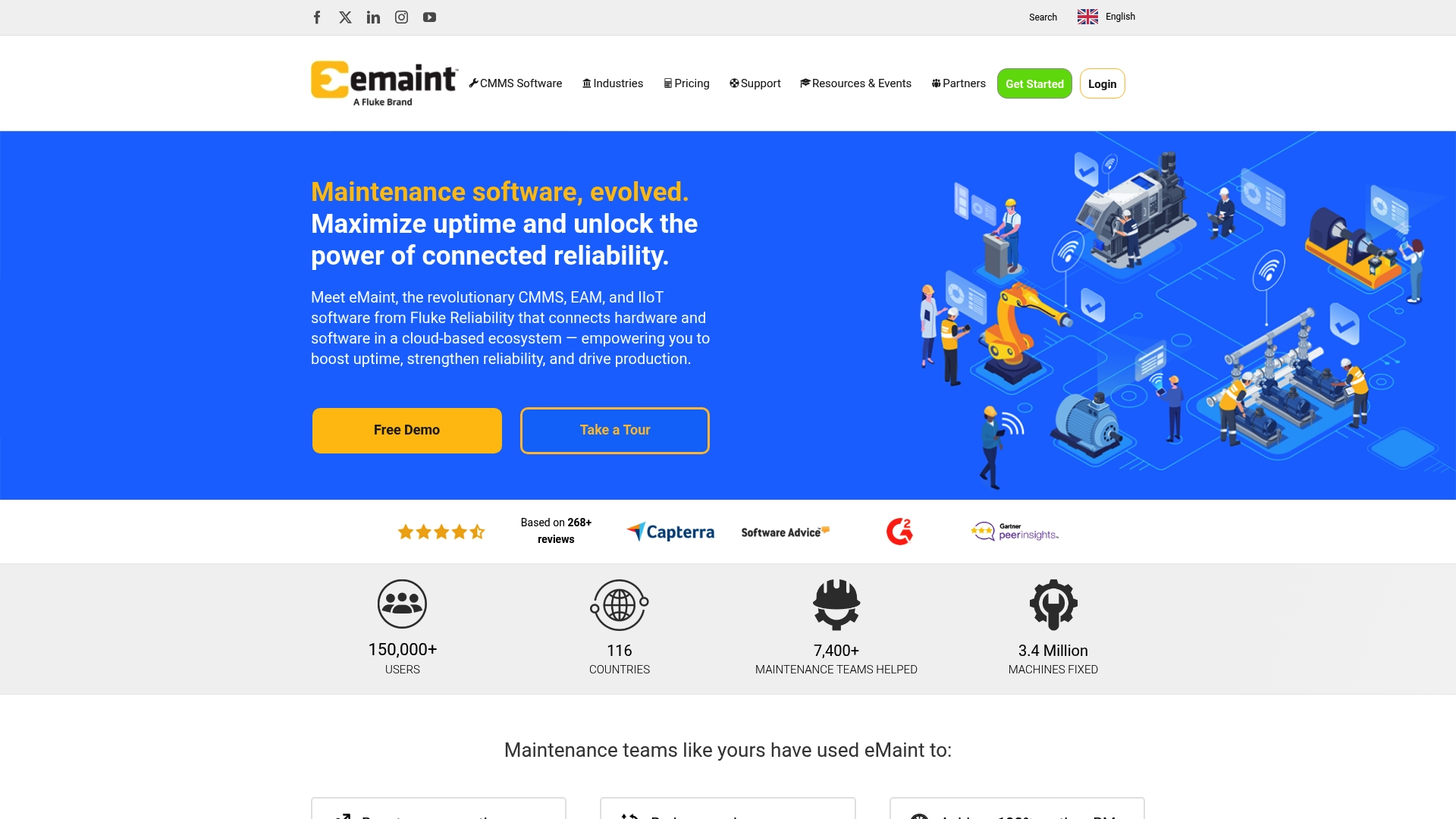
eMaint reports more than 150,000 users across 116 countries. That level of global adoption shows the platform aims at multi-site and enterprise maintenance teams. The product centers on connecting sensor feeds and asset records, so teams can shift from reactive fixes to scheduled and predictive work.
Core Features
eMaint combines structured asset management with work order scheduling and spare parts inventory so maintenance records follow assets through their lifecycle. The system includes drag and drop calendars, automation for recurring tasks, and enterprise reporting for KPIs and audits. It also accepts sensor and IIoT feeds to feed predictive maintenance models.
Key Differentiator
The platform ties hardware, sensors, and enterprise systems into a single cloud based ecosystem for connected reliability. That approach focuses on merging SCADA, PLC, and sensor inputs with work orders and parts records. It works best where teams want live condition data driving maintenance decisions.
Pros
eMaint emphasizes rapid time to value and strong customer care, which supports faster adoption in larger sites. The vendor advertises integrations with over 1,000 apps including ERP and BI systems, which helps pull equipment and production data into maintenance workflows. Multi site management, flexible pricing options, and enterprise reporting make it easier to standardize processes across plants.
Cons
-
The vendor does not publish many independent third party reviews, so outside performance comparisons are limited.
-
Pricing requires contacting sales, which makes budget forecasting harder for small operations.
-
The platform can feel complex for teams new to digital maintenance, which raises implementation overhead and training needs.
When It May Not Fit
Small plants that only need a basic work order board will likely find eMaint more than they need. Operations without an IT or maintenance analyst on staff will face a steeper learning curve. If transparent, fixed pricing is a priority, the inquiry based model may not match tight budget cycles.
Notable Integrations
-
Fluke sensors and other sensor data for condition monitoring and connected reliability.
-
ERP systems to align maintenance with procurement and production schedules.
-
SCADA and PLC data to ingest real time equipment signals.
-
BI and analytics platforms to export KPIs and audit dashboards.
Who It's For
eMaint fits maintenance managers, asset managers, and operations teams at manufacturing sites that manage many assets across multiple locations. It suits facilities ready to combine condition monitoring with formal preventive and predictive programs. The product targets organizations aiming to centralize reliability work and reporting.
Real World Use Case
The vendor says a manufacturing plant achieved 95% uptime after automating work orders and ingesting sensor feeds. Teams used centralized asset hierarchies and spare parts tracking to reduce unplanned downtime. That uptime figure illustrates how sensor driven workflows can change maintenance priorities.
Pricing
Pricing is available by inquiry. The website directs buyers to the pricing page for plan details and custom quotes.
Website: https://emaint.com
Comparison of alternatives
For manufacturers seeking quick deployment without the necessity of extensive system integration, several compelling alternatives are available. The selection comes down to balancing simplicity with features catering to specific operational needs, ranging from rapid implementation to integration flexibility and enterprise-grade analytics.
Deployment complexity and ease of use
Gemba Labs excels in its rapid deployment capabilities. With the ability to become operational within hours instead of weeks, Gemba Labs ensures minimal downtime during integration—an appealing proposition for small to mid-sized food manufacturers aiming for quick results without extensive IT intervention. Conversely, solutions like Fiix and eMaint, while offering features, require more initial setup efforts, which could delay operational benefits.
Scalability and integration
For manufacturing enterprises managing large and complex facilities, Fabrico.io offers profound integration support covering multi-site operations and legacy equipment connectivity. Additionally, its use of computer-vision technology provides an advanced level of operational insight. UpKeep also showcases integration with ERP systems, leveraging IoT-driven insights to enable predictive maintenance on a significant scale.
Best fit
- Manufacturing plants seeking fast deployment without requiring deep integration should consider Gemba Labs, which offers ground floor insights almost immediately.
- Medium to large enterprises managing assets across multiple sites with existing ERP systems might find UpKeep the most aligned with their requirements, given its extensive integration options.
- Plants handling legacy equipment and multi-site connectivity challenges will benefit from Fabrico.io’s infrastructure-oriented tools supporting enterprise operations.
- Operations centralized around sensor-driven reliability will find eMaint valuable, with its emphasis on connecting industrial IoT and analytics systems.
Our pick
Gemba Labs stands out for its direct applicability to small to mid-sized manufacturing facilities that prioritize simplicity and speed during deployment. By addressing specific operational challenges on the factory floor and combining sensor data with operator context, Gemba Labs creates a cohesive performance snapshot highly beneficial for rapid issue resolution and operational improvement. However, enterprises requiring deeper integrations or multi-plant scalability may find Fabrico.io or UpKeep better suited for their expanded needs.
Identify which software best aligns with your operational needs by comparing features, differentiators, pricing, and limitations in the table below.
| Product | Core Feature | Key Differentiator | Pricing | Notable Limitation |
|---|---|---|---|---|
| Gembalabs | Live performance monitoring via sensors | Rapid deployment, no SCADA dependency | Price not published | Limited suitability for large enterprises |
| UpKeep | Comprehensive work order and maintenance system | Embedded AI and IoT for automated maintenance | Starts at $24 per user/month | Overwhelming for small, single-site operations |
| Fabrico.io | MES and OEE integration with computer vision | AI-powered camera diagnostics and process optimization | Price not published | High upfront investment for broad deployments |
| Fiix CMMS | Asset and predictive maintenance system | Open platform emphasizing third-party integrations | Price not published | Complex setup for smaller teams |
| eMaint | Asset lifecycle management with IoT connectivity | Trusting IoT sensors throughout enterprise systems | Price not published | Learning curve for digital maintenance newcomers |
Challenges in Choosing MaintainX Alternatives for Food Manufacturing
Operations managers and plant supervisors at small to mid-sized food manufacturers often face delays and lack clear on-floor visibility. These challenges grow when integration budgets are tight and teams include bilingual operators needing easy workflows. Gembalabs solves this by combining machine cycle data with operator notes to provide detailed shift-level reports and early warnings without long IT projects.
Key benefits include:
- Rapid setup without SCADA dependencies
- Real-time updates every 60 seconds
- Bilingual support in English and Spanish
See how Gembalabs meets your needs for live production insight and improved communication on the factory floor at Gembalabs.
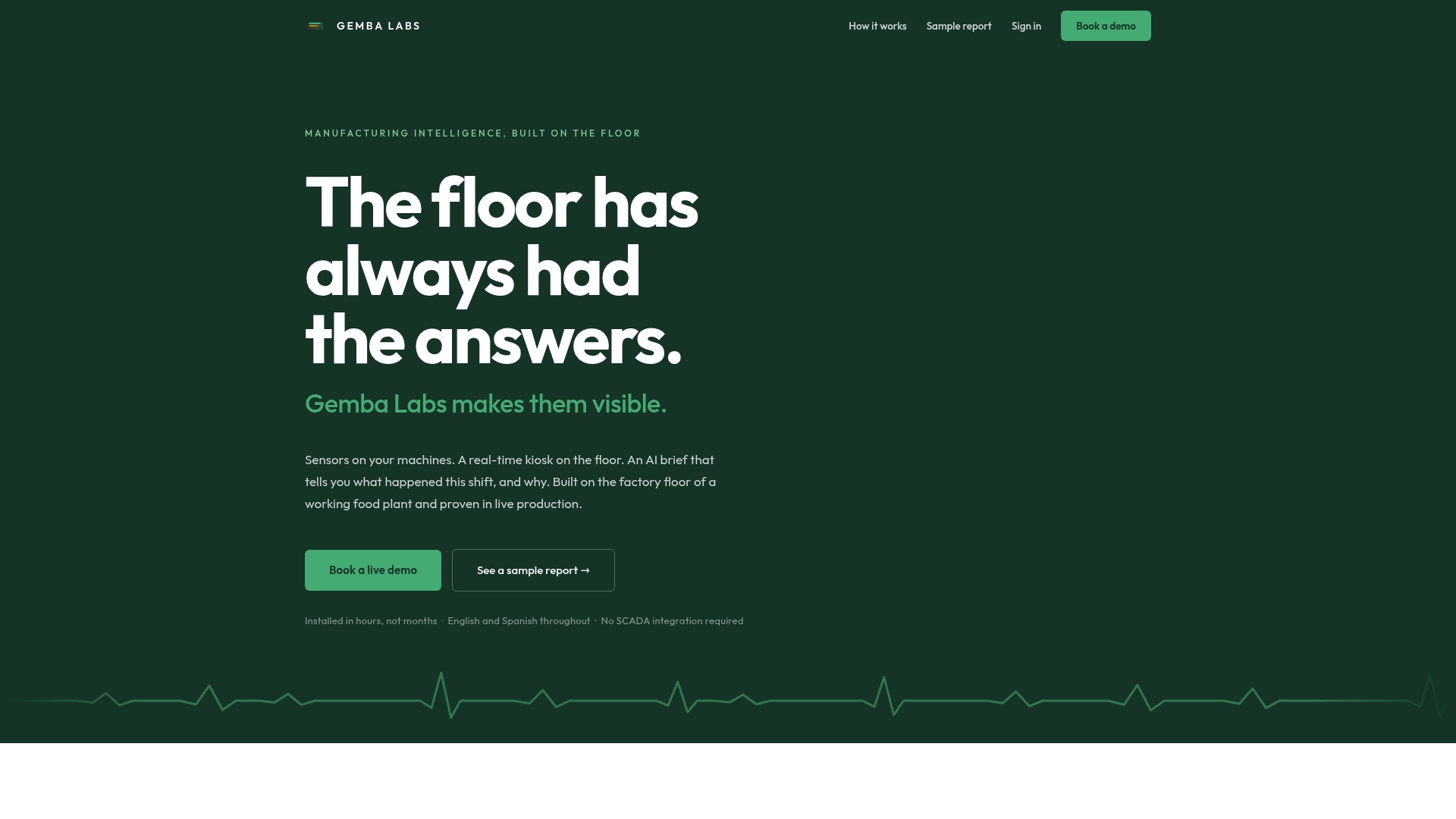
Review Gembalabs live performance scoreboards and start receiving detailed reports in hours, not months. Visit Gembalabs to learn how your facility can reduce downtime and boost operational clarity.
FAQ
What features make Gembalabs a strong choice for maintenance management?
Gembalabs offers a live performance scoreboard that updates every 60 seconds on the factory floor. This feature captures machine cycle data and operator notes for context, enhancing real-time visibility and decision-making. Teams should consider Gembalabs for actionable shift reports and early warnings in operations.
How does Gembalabs compare to UpKeep in terms of deployment speed?
UpKeep is noted for its mobile access and IoT sensor support, which enhances visibility and control over maintenance tasks. Gembalabs excels in rapid deployment, typically taking hours instead of months, which is ideal for small to mid-sized food manufacturers needing fast solutions. For those prioritizing speed, Gembalabs stands out significantly.
Which platform provides the best bilingual support for mixed-language crews?
Gembalabs includes built-in bilingual support in English and Spanish, reducing training friction for diverse teams. While other platforms may offer multilingual options, Gembalabs specifically tailors its features to ease adoption in mixed-language environments. This makes it a natural fit for operators who require seamless communication.
Does Gembalabs offer institutional memory for recurring maintenance issues?
Gembalabs utilizes pattern recognition to build institutional memory, helping to surface recurring problems automatically over time. This reduces the time spent diagnosing the same failures and speeds up corrective actions. Teams aiming to enhance long-term operational efficiency will benefit from this feature.
What should I expect in terms of pricing when considering Gembalabs?
Gembalabs does not list explicit pricing publicly, and interested buyers must contact the vendor for a quote. This allows for tailored solutions based on individual plant needs, ensuring potential customers find a suitable financial arrangement.