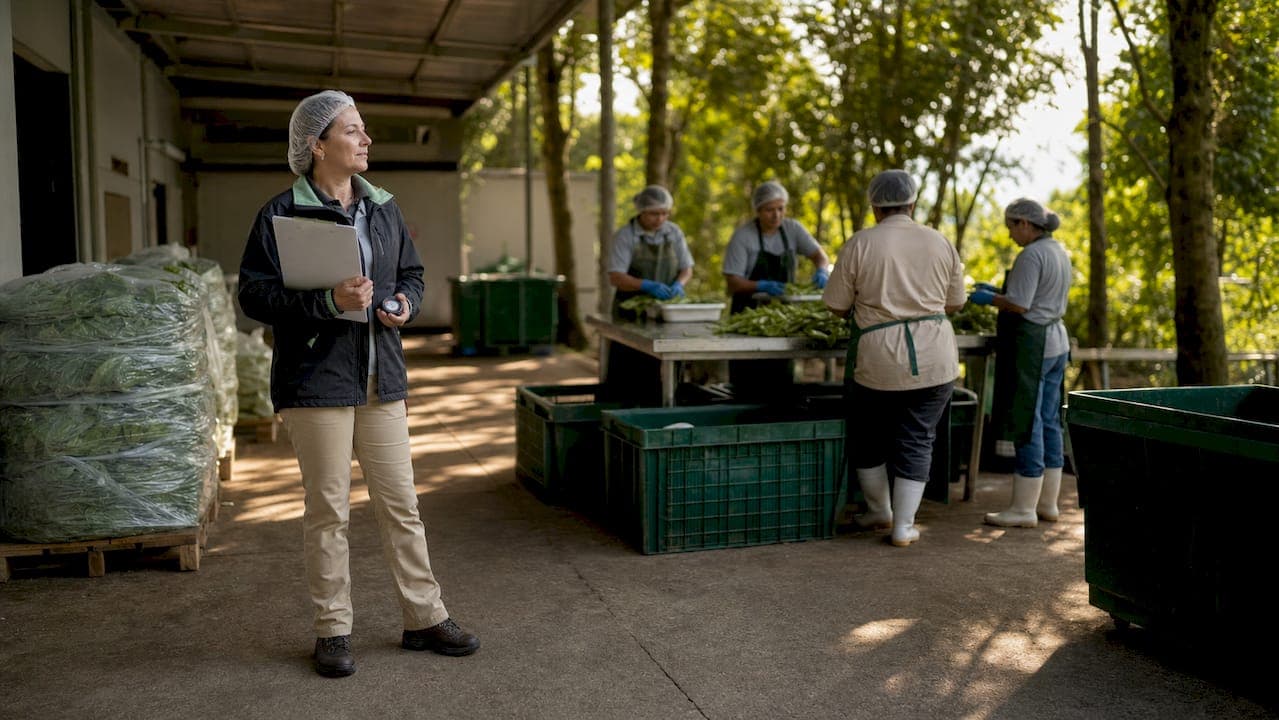
Standard work manufacturing is the documented best-known method for completing a production task, defined by three inseparable elements: takt time, work sequence, and standard work-in-process. For food manufacturers, this is not a bureaucratic exercise. It is the operational baseline that separates consistent, audit-ready production from a floor where every shift runs differently. Without a documented standard, you cannot measure variation, train new operators reliably, or sustain any improvement you make. Taiichi Ohno stated it plainly: "where there is no standard, there can be no Kaizen." That principle applies directly to every packaging line, mixing station, and filling cell in your facility.
What are the three core elements of standard work manufacturing?
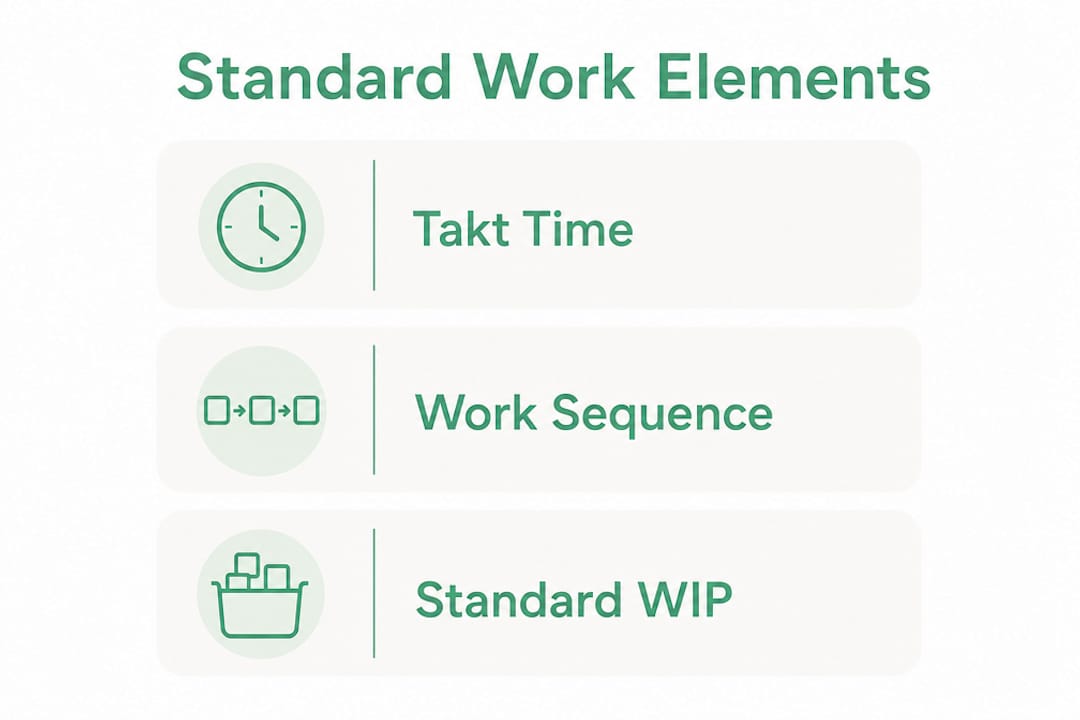
Standard work consists of three elements that must exist together. Remove any one of them and the standard breaks down. Each element answers a different question about how work should flow.
Takt time
Takt time is the maximum time available to complete one unit of output, calculated by dividing available production time by customer demand. In food manufacturing, this number sets the rhythm of the entire line. If your facility runs 450 minutes per shift and your customer requires 900 units, your takt time is 30 seconds per unit. Every operator task, machine cycle, and handoff must fit within that window. Takt time is not a target speed. It is the pace your process must match to meet demand without building excess inventory.

Work sequence
Work sequence is the exact, timed order of steps an operator follows to complete a task within takt time. This is not a general description of the job. It is a step-by-step record of every motion, quality check, and safety action, with the time each step takes. A well-documented sequence eliminates the guesswork that causes variability between operators and shifts. In a food facility, that variability often shows up as weight deviations, seal failures, or missed allergen checks.
Standard work-in-process
Standard work-in-process (SWIP) is the minimum number of units or containers that must be present in the process at any given time to keep the line flowing. Failure to define SWIP leads directly to line starvation or excess inventory piling up between stations. Both outcomes break the standard. SWIP is the buffer that allows each operator to complete their sequence without waiting or rushing.
The table below shows how each element functions and what breaks when it is missing.
| Element | Function | Failure mode when missing |
|---|---|---|
| Takt time | Sets the production pace to match demand | Overproduction or missed output targets |
| Work sequence | Defines the exact order and timing of operator steps | Variability between operators and shifts |
| Standard WIP | Maintains minimum inventory for continuous flow | Line starvation or inventory buildup |
How do you create effective standard work instructions?
The most common mistake in documenting standard work is writing it from an office. Capturing cycle times at the gemba with a real stopwatch, watching real operators on the actual line, produces standards that reflect what work actually takes. Engineering estimates consistently understate task time because they ignore micro-delays, tool retrieval, and quality checks that operators perform automatically.
Start by observing the task at least five times across different operators. Record each step with a verb and a measurable outcome. "Pick up bag" is not a step. "Pick up bag from conveyor, verify seal tab is intact, place flat on scale" is a step. That level of detail is what makes the instruction trainable and auditable.
Break the documentation into five columns: step number, step description, key point, reason for the key point, and cycle time. The "reason" column is the one most teams skip. It is also the column that drives operator buy-in. When an operator understands why a step matters, they follow it consistently and flag it when conditions change.
- Observe the task five or more times with a stopwatch at the actual workstation.
- Record every step using an action verb and a measurable outcome.
- Identify key points, which are the actions that most affect quality, safety, or cycle time.
- Document the reason for each key point in plain language the operator can read and remember.
- Add annotated photographs showing the correct method, with a side-by-side image of the incorrect method where the risk is high.
- Record cycle time for each step and confirm the total fits within takt time.
- Have someone unfamiliar with the task attempt to follow the instruction before finalizing it.
Annotated real photographs and quality check visuals reduce errors and cut training time significantly. Text-heavy instructions get ignored on the floor. A photo showing the correct fill level on a jar, with a red circle marking the reject threshold, communicates in seconds what three sentences cannot.
Pro Tip: Update standard work instructions monthly for any station undergoing kaizen. A standard that does not reflect the current best method becomes a liability, not an asset.
The standard work combination table is a companion document worth building alongside your written instructions. It maps operator motion time, machine time, and walking time on a single chart, making it easy to spot where an operator is waiting on a machine or where two tasks overlap in ways that create risk.
Best practices for implementing and sustaining standard work in food operations
Training is where most standard work programs fail. Posting a laminated sheet at a workstation is not training. The Job Instruction method, developed within the Training Within Industry framework, teaches operators in four steps: show the task, explain the key points, explain the reasons, and then have the operator perform it while you observe. Sustained success with standard work requires confirming that what operators do on the floor matches what the document says, not just once at onboarding, but on a recurring basis.
Audit cadence matters as much as audit design. A weekly five-minute observation by a team leader, focused on one or two steps rather than the entire task, catches drift before it becomes a defect. The goal of the audit is coaching, not discipline. When operators know that audits lead to better tools or clearer instructions rather than write-ups, they participate honestly.
Visual management accelerates adoption. The most effective deployment methods for food manufacturing floors include:
- Posting standard work at the point of use, at eye level, with laminated photos and a QR code linking to the digital version.
- QR code access and multilingual support in 200+ languages, which removes the language barrier that causes costly errors in diverse workforces.
- Color-coded quality checkpoints that match the visual cues already present on the line, such as fill level marks on containers or torque indicators on caps.
- A clear revision date and version number on every posted document, so operators know they are reading the current standard.
Pro Tip: Align your standard work revision cycle with your kaizen event schedule. Every improvement event should end with an updated standard, not just a new idea on a whiteboard.
The most common failure mode is treating standard work as a static document. A standard written in january that has not been touched by july is almost certainly wrong. Equipment wears, recipes change, and operators find better methods. Standard work is a stable but evolving document that captures the current best method, with the expectation that the current best method will improve.
Common challenges when adopting standard work in food production
The gap between theory and floor reality is where most implementations stall. Recognizing the specific failure modes in food manufacturing helps you address them before they undermine the program.
"The standard work document is only as good as the observation behind it. If you timed the task on a good day with your best operator, you built a standard that most of your team cannot meet. That is not a standard. That is a wish."
Over-reliance on engineering estimates. Theoretical cycle times ignore the real conditions on your floor, including tool retrieval, sanitation checks between batches, and the time it takes to verify a label before applying it. Always time the task with a stopwatch at the actual station, using multiple operators across multiple shifts.
Documentation that goes stale. A standard work instruction that does not reflect the current process is worse than no instruction at all. It trains operators to do the wrong thing with confidence. Assign ownership of each standard to a specific team leader, with a defined review date.
Inaccessible procedures. A binder in the supervisor's office does not count as accessible. Instant access at the point of need prevents errors and rework. QR codes, digital displays, and mobile-accessible formats solve this problem at low cost.
Excluding operators from the process. Successful standard work implementation is a human-centered process that requires operator involvement and frequent validation. Operators who helped write the standard follow it. Operators who had it handed to them often do not.
Missing SWIP definitions. Many food manufacturers document takt time and work sequence but skip SWIP entirely. The result is line stalls when an upstream station runs slow and inventory pileups when it runs fast. Define the minimum WIP for every station before you post the standard.
Key Takeaways
Standard work manufacturing succeeds when takt time, work sequence, and standard WIP are documented together, validated by frontline operators, and updated after every improvement event.
| Point | Details |
|---|---|
| Three elements are inseparable | Takt time, work sequence, and SWIP must all be defined for the standard to hold. |
| Observe at the gemba | Time tasks with a stopwatch on the actual floor, not from engineering estimates. |
| Visual instructions outperform text | Annotated photos and QR codes drive adoption and reduce errors on the floor. |
| Audits should coach, not punish | Weekly observations focused on one or two steps catch drift before it becomes a defect. |
| Standard work is a living document | Update instructions after every kaizen event to reflect the current best method. |
What I've learned from watching standard work programs succeed and fail
Most standard work programs fail in the same place: the gap between the document and the floor. Teams spend weeks building beautiful binders, then post them in a break room and wonder why nothing changes. The document is not the standard. The behavior on the floor is the standard. The document is only useful if it reflects and drives that behavior.
The food manufacturers I've seen get this right share one habit. They treat the standard work instruction as a conversation starter, not a final answer. When an operator says "I do it differently," the response is not "follow the standard." The response is "show me." Sometimes the operator has found a better method. Sometimes they have found a safety risk. Either way, the conversation improves the standard.
Integrating standard work with your scheduling and quality data is where the real gains compound. When your documented cycle times match your actual throughput data, your scheduling accuracy improves. When your quality checkpoints are built into the work sequence, your defect rate drops without adding inspection steps. Small, consistent improvements in both areas add up to meaningful reductions in rework and waste over a production year. Gembalabs connects equipment cycle data and operator performance data in one place, which makes it much easier to see when actual performance is drifting from the documented standard before that drift becomes a quality event.
— Trevor
How Gembalabs supports standard work on the food manufacturing floor
Gembalabs gives food manufacturers a direct line between what the standard says and what the floor actually does. The platform pulls raw data from equipment cycles and combines it with human performance data, including downtime events and rework counts, to show you where your process is drifting from the documented standard.
When you connect that data to your standard work cycle times, you can see which stations are running long, which operators need coaching, and which standards need updating. Gembalabs also generates AI-driven reports on the specific metrics you want to track, so your team leaders spend time coaching rather than pulling numbers. If you want to see what that looks like in practice, the Gembalabs manufacturing intelligence platform shows how the system works across a live food manufacturing environment. You can also review a sample report to see the kind of operational insight it produces.
FAQ
What is standard work in manufacturing?
Standard work is the documented current best-known method for completing a task, defined by takt time, work sequence, and standard work-in-process. It serves as the baseline for training, auditing, and continuous improvement.
What is the difference between standard work vs SOP?
SOPs focus on compliance and general guidelines, explaining what to do and why. Standard work specifies exactly how to do it, in what sequence, and in how much time, making it the more granular and improvement-focused document.
How do you implement standard work in food manufacturing?
Start by observing tasks at the workstation with a stopwatch, document each step with a verb and measurable outcome, add annotated photos, and confirm the instruction works by having an unfamiliar operator follow it before posting it on the floor.
How often should standard work instructions be updated?
Update standard work instructions monthly for any station undergoing active improvement. Every kaizen event should produce an updated standard that reflects the new best method, with a revised date and version number posted at the workstation.
Why does standard work-in-process matter?
SWIP defines the minimum inventory needed to keep the line flowing without stalls or buildup. Without it, even a well-documented work sequence will break down when upstream or downstream stations run at different speeds.