
Traceability in food manufacturing is the systematic process of documenting and linking every step a food product takes from raw ingredient receipt through processing and shipping to final distribution. The FDA's FSMA 204 rule requires manufacturers to retrieve traceability records within 24 hours of a request, with enforcement set for July 2028. That deadline is closer than most quality teams realize. The Global Food Safety Initiative (GFSI) schemes, including SQF and BRC, independently require documented traceability as a certification condition. Together, these frameworks make food supply chain visibility a non-negotiable operational requirement, not an optional upgrade.
What is traceability in food manufacturing, and why does it matter?
Traceability in food manufacturing is defined as the ability to follow a food product forward through the supply chain and trace it backward to its source at any point. The industry term for this capability is "bidirectional traceability," and it covers every transformation a product undergoes from raw material to finished good. Without it, a contamination event forces a manufacturer to guess which products are affected, which almost always means a broader and more expensive recall.
The practical stakes are high. A manufacturer that cannot identify which lot of a raw ingredient went into which finished product batch has no way to contain a recall to the affected units. Every hour of uncertainty expands the recall scope and the liability. FSMA 204 exists precisely because paper-based systems and disconnected spreadsheets cannot meet the 24-hour retrieval standard under real audit conditions.

Traceability also creates direct operational value beyond compliance. Viewing traceability as an operational enabler rather than a compliance cost allows manufacturers to use supply chain data for inventory optimization and spoilage reduction. That shift in perspective changes how quality teams budget for and build their traceability programs.
What are Critical Tracking Events (CTEs) and Key Data Elements (KDEs)?
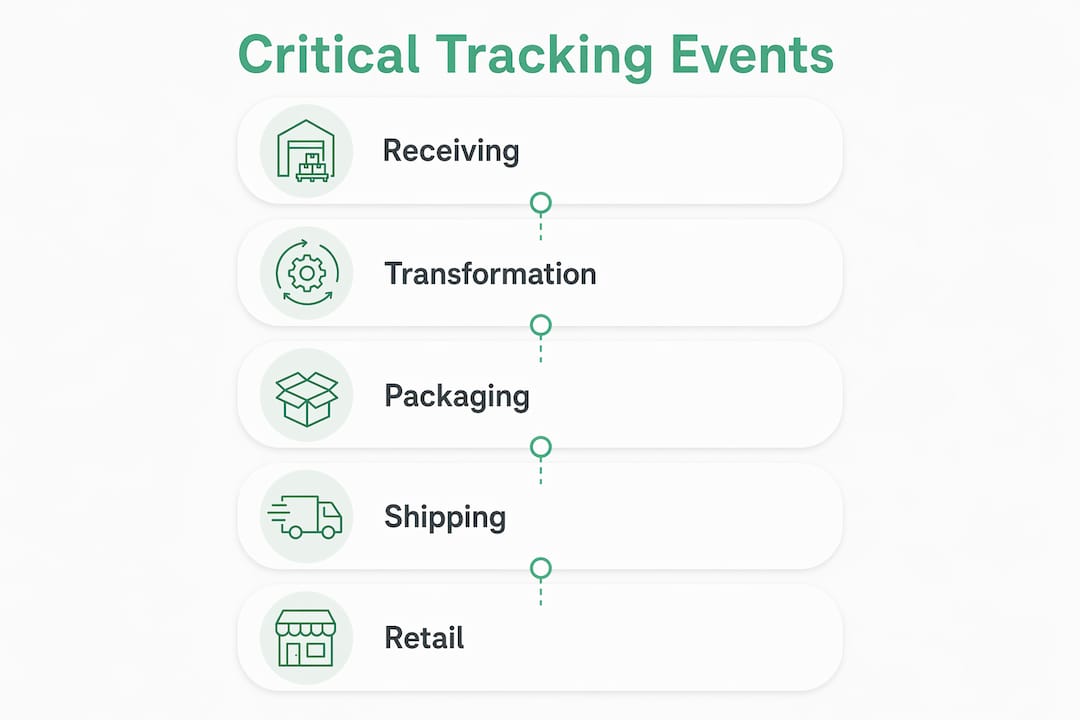
Critical Tracking Events (CTEs) are the specific points in a food product's journey where traceability data must be captured. FSMA 204 identifies three primary CTEs for food manufacturers:
- Receiving: The moment a raw ingredient or input arrives at your facility. Required data includes the supplier name, lot code, quantity, and date received.
- Transformation: Any processing step that changes the form, identity, or lot composition of a product. This is where most traceability gaps occur.
- Shipping: The point at which a finished product leaves your facility. Required data includes the recipient, lot code, quantity, and ship date.
Key Data Elements (KDEs) are the specific data points captured at each CTE. Lot codes, dates, quantities, and product descriptions are the core KDEs required to enable 24-hour data retrieval. A lot of code structure that includes the production date, shift, and line number gives investigators a direct path to the affected batch without manual searching.
The transformation CTE deserves special attention. When a manufacturer blends two incoming lots into a single batch, the new batch must carry a Traceability Lot Code (TLC) that links back to both source lots. Batch identification is the backbone of traceability, and failures most commonly stem from weak rules for batch assignment during processing transformations. A blending operation that does not generate a new TLC with documented parent lot links creates an untraceable gap.
Pro Tip: Establish a written batch ID assignment rule before you automate. Define exactly when a new TLC is required, such as any blend, cook, or repack operation, so your system generates linkages consistently rather than relying on operator judgment.
Documentation workflows for CTEs should be standardized across shifts. A receiving log that captures supplier lot codes in a consistent format, a transformation record that maps input lots to output TLCs, and a shipping log that ties finished goods to customer orders form the minimum documentation set for FSMA 204 readiness.
How do modern digital technologies improve food supply chain visibility?
Digital technology does not automatically solve a traceability problem. It amplifies whatever data discipline already exists in your operation. That distinction matters because many manufacturers mistakenly believe FSMA 204 only digitizes records when it actually requires structured, linkable lot data at each transformation stage. Scanning a paper log into a PDF does not create a traceable record.
The technologies that genuinely improve food supply chain visibility include:
- Barcodes and QR codes: The most cost-effective entry point for lot-level tracking. GS1-128 barcodes encode lot codes, expiration dates, and quantities in a standardized format that most enterprise systems can read without custom integration.
- RFID: Radio frequency identification enables high-volume, hands-free scanning at receiving and shipping docks. RFID reduces manual entry errors and speeds up the capture of KDEs at high-throughput facilities.
- IoT sensors: Temperature and humidity sensors attached to shipments or storage units provide condition data alongside location data. Traceability systems that integrate real-time shipment, temperature, and custody data reduce spoilage and recall risks while improving operational efficiency.
- Interoperable software platforms: GS1 standards provide a common data language that allows your system to exchange lot-level data with suppliers and customers without manual reconciliation.
The connectivity gap between supply chain partners is the most underestimated challenge in digital traceability. Disconnected systems between supply chain partners cause manual reconciliation issues, making interoperable data standards critical for success. A manufacturer running a modern platform still faces gaps if a key supplier sends lot data in a non-standard format or via email.
Pro Tip: Supplier data governance must come before system automation. Audit your top ten suppliers for batch numbering consistency and certificate of analysis (COA) format before you go live with any digital traceability platform. Clean supplier data takes months to establish and cannot be fixed retroactively.
75% of food shippers invest in supply chain visibility technology, yet 26% do not monitor temperature-controlled shipments. That gap shows that technology investment alone does not close visibility risks. The condition monitoring piece requires deliberate integration, not just hardware deployment.
Why is bidirectional traceability essential, and how do you implement it?
Bidirectional traceability means your system can move in two directions: backward from a finished product to its source ingredients, and forward from a raw material to every finished product it entered. Both directions are required for effective recall management.
Backward traceability
Backward traceability starts with a customer complaint or a positive test result and works upstream. The goal is to identify the specific supplier lot, the receiving date, and the storage location of the implicated ingredient. A well-structured receiving log with supplier lot codes linked to your internal lot codes makes this a minutes-long query rather than a days-long investigation.
Forward traceability
Forward traceability starts with a raw material lot and identifies every finished product batch it entered, every customer it shipped to, and every unit still in inventory. This direction is what limits recall scope. A manufacturer who can run a forward trace in under an hour can issue a targeted recall. One who cannot must issue a broad recall covering all products made during an extended period.
The table below outlines the documentation requirements for each trace direction.
| Trace direction | Starting point | Key records needed | Goal |
|---|---|---|---|
| Backward | Customer complaint or test result | Receiving logs, COAs, supplier lot codes | Identify source ingredient and lot |
| Forward | Raw material lot code | Transformation records, finished goods logs, shipping records | Identify all affected products and customers |
Regular mock recalls and traceability tests significantly reduce recall response times and help meet audit requirements. Quarterly or annual mock recalls are the recommended frequency. A mock recall should test both directions, measure the time to complete the trace, and document any gaps found. Gaps found in a mock recall are far less costly than gaps found during an FDA investigation.
Record retention policy ties directly to bidirectional traceability readiness. The best practice retention period is the product shelf life plus one additional year. A product with a 24-month shelf life requires records kept for at least 36 months. Retention policies shorter than this leave manufacturers unable to respond to late-emerging complaints or regulatory inquiries.
What are best practices for traceability record management and recall readiness?
Organized record keeping is the difference between a two-hour trace and a two-day scramble. The following practices define a recall-ready traceability program:
- Standardize lot code formats across all shifts and lines. A lot code that changes format between operators creates search failures during a trace. Define the format in a written procedure and enforce it through system validation or label templates.
- Retain the full documentation set. Receiving logs, certificates of analysis, batch records, transformation logs, and shipping documents must all be retained and cross-referenced by lot code.
- Operationalize the 24-hour retrieval rule now. The FDA's 24-hour record retrieval requirement applies to foods on the Food Traceability List. Test your retrieval speed before an auditor does.
- Integrate traceability into daily workflows. Traceability that requires a separate manual step at the end of a shift will fail under production pressure. Scanning lot codes at receiving, transformation, and shipping must be built into the standard operating procedure for each activity.
- Train every operator who touches a lot code. Automated scanning reduces human error, but operators who understand why lot codes matter catch exceptions that systems miss.
Supplier data inconsistencies are the most common bottleneck in real-world traceability programs. A supplier who ships the same product under different lot code formats across deliveries forces your team to manually reconcile records before a trace can run. Supplier data governance, including consistent batch numbering and standardized certificates, must be established months before automation to avoid slow or incomplete traceability during audits and recalls.
Pro Tip: Build a supplier scorecard that includes lot code format compliance as a rated criterion. Suppliers who consistently deliver non-standard data cost you time during every audit and every recall. Make the expectation explicit in your supplier agreements.
Key Takeaways
Effective traceability in food manufacturing requires structured lot data, bidirectional trace capability, and tested recall procedures that meet the FDA's 24-hour retrieval standard.
| Point | Details |
|---|---|
| CTEs and KDEs are mandatory | Capture lot codes, dates, and quantities at receiving, transformation, and shipping for every batch. |
| Digital tools require clean data | Technology amplifies existing data discipline; fix supplier data governance before automating. |
| Bidirectional traceability limits recall scope | Forward and backward trace capability lets you contain recalls to affected lots rather than broad product lines. |
| Mock recalls reveal real gaps | Run quarterly or annual mock recalls in both trace directions and measure completion time against the 24-hour standard. |
| Record retention must match shelf life | Keep traceability records for the product shelf life plus one year to cover late-emerging complaints and audits. |
Traceability as a live operational tool, not a filing system
Most quality teams I have worked with treat traceability as a recordkeeping obligation. They build a system that satisfies an audit, file the records, and move on. That approach works until a recall happens, and then it fails in the most expensive way possible.
The manufacturers who handle recalls well are the ones who treat traceability as a live operational tool. They run their lot code data the same way a logistics team runs a shipment tracker. They know where every active lot is, what condition it is in, and which customers hold it. When a problem surfaces, they already have the answer.
The shift from static records to live visibility is real and accelerating. Integrating shipment data, temperature monitoring, and custody records into a single traceable thread is no longer a large-enterprise capability. Mid-sized manufacturers can build this now with the right platform and the right data discipline. The challenge is not the technology. The challenge is the organizational commitment to clean, consistent data at every step.
Blockchain and AI analytics are the next layer. AI can flag anomalies in lot code patterns before a human reviewer notices them. Blockchain creates immutable audit trails that regulators and retail customers increasingly request. Neither technology replaces the fundamentals. A blockchain record of a bad lot code is still a bad lot code. The foundation has to be right first.
— Trevor
How Gembalabs supports FSMA 204 compliance for food manufacturers
Food manufacturers who need to close the gap between their current recordkeeping and FSMA 204 compliance have a concrete path forward with Gembalabs.
Gembalabs is a food manufacturing software platform built for small and mid-sized operations. It compiles raw data from equipment cycles alongside human data such as downtime and rework issues, giving quality teams a detailed view of what is happening across the facility. The platform integrates with AI to generate reports on the specific items your team needs to track, including lot code management and recall simulation workflows. For quality assurance professionals who need audit-ready records and faster trace response times, Gembalabs connects the operational data your facility already generates into a structured, retrievable format.
FAQ
What is the FDA's deadline for FSMA 204 traceability compliance?
The FDA has postponed enforcement of FSMA 204 traceability requirements to july 2028. Manufacturers handling foods on the Food Traceability List must be able to retrieve records within 24 hours of an FDA request.
What foods are covered under FSMA 204?
FSMA 204 applies to foods on the FDA's Food Traceability List, which includes leafy greens, shell eggs, nut butters, fresh-cut fruits and vegetables, finfish, crustaceans, and certain cheeses. Manufacturers should verify their specific products against the current FDA list.
What is the difference between backward and forward traceability?
Backward traceability traces a finished product back to its source ingredients and suppliers. Forward traceability tracks a raw material lot forward through all finished products it entered and all customers who received those products.
How often should manufacturers run mock recalls?
Quarterly or annual mock recalls are the recommended practice. Each test should cover both trace directions, measure the time to complete the trace, and document any data gaps found.
How long should traceability records be retained?
The best practice retention period is the product shelf life plus one additional year. This covers late-emerging consumer complaints and regulatory inquiries that arise after a product has left the market.