
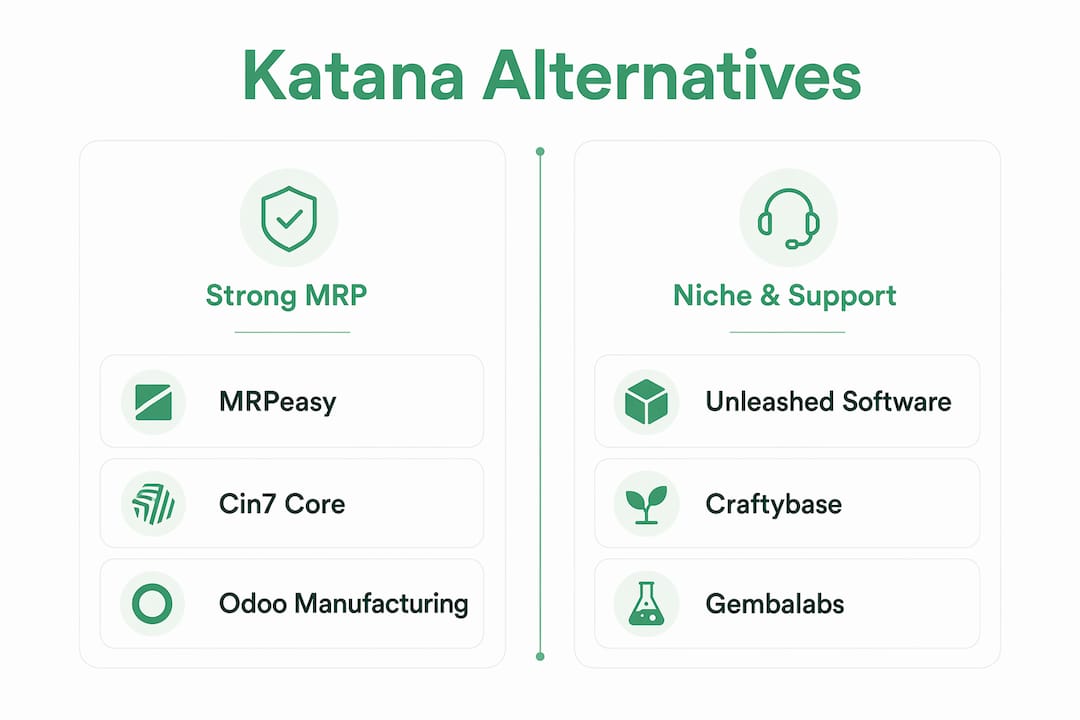
If you're weighing Katana MRP alternatives, the short answer is this: the right pick depends almost entirely on whether manufacturing or multi-channel selling is the core of your business. For true production depth, MRPeasy is the closest like-for-like swap. For inventory and marketplace sync, Cin7 Core or Unleashed Software handle the heavy lifting. For small-batch makers on a tight budget, Craftybase or inFlow get the job done without the complexity.
Here's a quick orientation to the field:
- MRPeasy — Cloud MRP with BOMs, scheduling, and ERP extensions; best for small manufacturers wanting production depth
- Cin7 Core — Feature-rich inventory and light manufacturing with broad integrations; best for mid-market operations
- Unleashed Software — Inventory and light BOM management with strong reporting; best for wholesalers and distributors
- WhiteBox — Multi-channel inventory and fulfillment with marketplace sync; best for multi-channel sellers
- Odoo Manufacturing — Modular open-source ERP; best for teams wanting one system across all business functions
- Prodio — Simple production control with growing inventory features; best for manufacturers who want minimal setup
- inFlow — Straightforward inventory with barcode support; best for small teams prioritizing ease of use
- Sumtracker — Real-time stock sync across e-commerce channels; best for multi-channel retailers
- Zoho Inventory — Inventory and order management inside the Zoho ecosystem; best for teams already using Zoho CRM or Books
- Craftybase — Batch production and cost tracking for artisan makers; best for small-batch craft manufacturers
- Fishbowl Inventory — QuickBooks-compatible inventory with light manufacturing; best for manufacturers already on QuickBooks
- NetSuite — Full ERP with global supply chain; best for larger manufacturers ready to invest in enterprise infrastructure
- Acumatica — Modular cloud ERP with manufacturing and financial management; best for mid-sized businesses
- Arda — Shop-floor replenishment with Kanban-style workflow control; best for manufacturers prioritizing floor-level visibility
- Fabrikator — Flexible BOM and production workflow management; best for manufacturers needing customizable workflows
- Inventory Planner by Sage — Demand forecasting integrated with Sage ERP; best for manufacturers focused on planning accuracy
- Cogsy — Demand and production forecasting for fast-moving consumer goods; best for CPG producers
- Finale Inventory — Cloud inventory and order management with shipping integrations; best for small to medium businesses centralizing stock control
What do the best Katana MRP alternatives actually offer?
The gap between these tools is wider than most comparison pages let on. Some are genuine MRP systems. Others are inventory managers that borrowed a few manufacturing terms for their marketing copy.
| Product | Best For | Key Features | Starting Price | Integrations |
|---|---|---|---|---|
| MRPeasy | Small manufacturers needing ERP breadth | Production planning, BOMs, scheduling, procurement | Per-user tiers | Accounting, some e-commerce |
| Cin7 Core | Mid-market multi-channel operations | Inventory, light manufacturing, purchasing, B2B | ~$349/mo | Broad marketplace + accounting |
| Unleashed Software | Wholesalers and distributors | Inventory, light BOM, reporting, B2B store | ~$399/mo | Accounting, B2B store |
| WhiteBox | Multi-channel sellers and 3PL | Marketplace sync, multi-warehouse, fulfillment | — | Shopify, Amazon, Lazada, Shopee, TikTok Shop |
| Odoo Manufacturing | Teams wanting one modular ERP | Manufacturing, inventory, sales, accounting apps | Per-user + per-app | Large app ecosystem |
| Prodio | Simple production control | Production tracking, growing inventory features | — | — |
| inFlow | Small teams prioritizing simplicity | Inventory, barcode scanning, e-commerce connections | Tiered | E-commerce + accounting |
| Sumtracker | Multi-channel retail sync | Real-time stock sync, forecasting | — | Marketplace integrations |
| Zoho Inventory | Zoho ecosystem users | Multi-channel inventory, order management | Tiered | Zoho CRM, Books, e-commerce |
| Craftybase | Small-batch and craft makers | Batch production, cost tracking, materials | — | — |
| Fishbowl Inventory | QuickBooks-dependent manufacturers | Work orders, MRP, barcoding, QuickBooks sync | $$$ | QuickBooks |
| NetSuite | Large manufacturers scaling globally | Full ERP, supply chain, financials, CRM | $$$$ | Extensive ecosystem |
| Acumatica | Mid-sized manufacturers | Cloud ERP, manufacturing, financial management | — | Broad ERP integrations |
| Arda | Shop-floor replenishment | Kanban-style workflow, scheduling | $$ | — |
| Fabrikator | Customizable BOM workflows | BOM management, production workflow | — | — |
| Inventory Planner by Sage | Demand forecasting | Forecasting, inventory optimization | — | Sage ERP |
| Cogsy | CPG demand planning | Demand forecasting, production planning | — | — |
| Finale Inventory | Centralized inventory control | Cloud inventory, order management, shipping | — | Multi-channel |
MRPeasy is the strongest like-for-like replacement for Katana's manufacturing core. It covers production planning and BOMs with ERP-style extensions for procurement and CRM, and it's priced in per-user tiers, so costs stay proportional as your team grows. If you're leaving Katana because you want more manufacturing depth rather than less, MRPeasy deserves a trial before anything else.
Cin7 Core (formerly DEAR) takes a different angle. It's a deep platform covering inventory, light manufacturing, purchasing, and B2B sales across a wide range of marketplace and accounting integrations. The trade-off is cost, starting at roughly $349 per month, and a learning curve that typically requires proper onboarding. Teams that need breadth and have the patience to configure it will get a lot out of it.
Unleashed Software leans toward wholesale and distribution rather than true manufacturing. Its BOM features handle simple assembly, but it won't replace Katana's shop-floor control for complex production environments. At a higher monthly fee compared to many alternatives, justified mainly by its reporting depth and built-in B2B store.
Odoo Manufacturing is worth considering if you want to consolidate your entire business into one system. Manufacturing is one module among many, alongside inventory, sales, accounting, and e-commerce. The catch is implementation complexity and a pricing model that combines per-user and per-app fees, which can add up fast without careful planning.
For small-batch makers and artisans, Craftybase fills a niche that most MRP tools ignore: tracking materials, batch costs, and production runs at a scale that doesn't justify a $300-per-month subscription. Similarly, inFlow suits small teams that need clean inventory management with barcode support but don't require shop-floor control or complex BOM handling.
Pro Tip: Before you commit to any platform, map out your actual production complexity. If your BOMs have more than two levels or you run concurrent work orders, tools like inFlow or Craftybase will hit their ceiling fast. MRPeasy or Cin7 Core are the safer long-term bets for anything beyond simple assembly.
How do pricing models compare across these alternatives?
Pricing across this category varies significantly, with complex platforms starting at several hundred dollars monthly, and simpler tools available for less than one hundred dollars per month. That gap sounds obvious, but the real cost difference shows up when you start adding users, channels, and order volume.
Key pricing patterns to know:
- Per-user pricing (MRPeasy, Odoo): costs scale directly with team size; confirm the total for your actual headcount before signing
- Flat tiered plans (Cin7 Core, Unleashed, inFlow): fixed monthly fee per tier, with feature gates between levels
- Per-user plus per-app (Odoo): the most unpredictable model, especially if you activate multiple modules over time
- Free trials: most platforms in this category offer a 14-day or 30-day trial; WhiteBox offers a 14-day free trial with entry-level pricing below fifty dollars per month
Implementation costs are a separate line item that most buyers underestimate. Cin7 Core and Odoo typically require onboarding support, which adds to the first-year total. MRPeasy and inFlow are generally self-serve, with setup measured in days rather than weeks. NetSuite and Acumatica sit at the enterprise end, where implementation timelines and partner fees can dwarf the software subscription itself.
One practical note: free trials are widely available, but they rarely reflect real-world complexity. Run a trial with your actual product catalog, your real BOM structure, and a representative order volume. A tool that feels smooth with sample data can behave very differently under your actual workload.
How do you choose the right alternative for your manufacturing business?
The single most important question is whether your business is primarily a manufacturer or primarily a seller of finished goods. That distinction shapes every other decision.
Key factors to work through:
- Business model fit: if production scheduling and raw material consumption are daily realities, you need a true MRP like MRPeasy or Cin7 Core. If you buy finished goods and resell across channels, a multi-channel inventory tool like WhiteBox or Zoho Inventory is a better match
- BOM complexity: single-level BOMs for simple assembly work fine in inFlow or Unleashed. Multi-level BOMs with sub-assemblies and routing steps require MRPeasy, Cin7 Core, or Acumatica
- Shop-floor control: Katana's visual production scheduling is one of its strongest features. MRPeasy and Arda are the closest replacements if that visibility matters to your floor supervisors
- Integration requirements: if you're on QuickBooks, Fishbowl Inventory is purpose-built for that connection. If you're on Shopify or WooCommerce, Katana itself integrates well, but so do Cin7 Core and Zoho Inventory
- Budget ceiling: set a realistic monthly ceiling that includes users, add-ons, and implementation. Tools that look affordable at the base tier can double in cost once you add the features you actually need
For teams selling across multiple e-commerce channels, production tracking software that connects natively to your marketplaces will save more time than any MRP feature you're unlikely to use.
Pro Tip: You don't have to pick one tool for everything. Many manufacturers run a light MRP for production planning and a separate multi-channel inventory platform for finished-goods sales, connected via API. The combination often costs less than a single enterprise ERP and avoids paying for features that don't fit your workflow.

Manufacturing intelligence insights that should shape your software decision
The feature list on a vendor's pricing page rarely tells you what actually matters on the floor. The distinction that separates useful software from expensive shelf-ware is whether it gives you visibility into what's going wrong, not just what's happening.
True manufacturers need three things that retailers don't: shop-floor control, production variance tracking, and BOM handling that reflects how products are actually built, not just how they're sold. Retailers and distributors, by contrast, need native marketplace integrations and real-time stock sync across channels. Buying the wrong category of tool is the most common and most expensive mistake in this space.
Real-time production monitoring changes how quickly you can respond to problems. When a machine goes down or a batch fails inspection, the time between the event and the decision to act is where money is lost. Software that surfaces that gap in real time, rather than in a weekly report, gives floor managers something they can actually use. This is where manufacturing quality control software becomes relevant alongside your MRP choice, particularly for food and regulated manufacturing environments.
For food manufacturers specifically, the stakes around traceability and downtime visibility are higher than in most other sectors. An MRP tool that tracks BOMs and schedules production runs is necessary but not sufficient. You also need to know why a line stopped, which operator was involved, and whether the same issue has recurred across shifts. That level of production reporting sits outside the scope of most MRP platforms.
Key signals that your current or prospective software is falling short:
- You're exporting data to spreadsheets to answer basic questions about downtime or yield
- Your floor supervisors don't use the system because it doesn't reflect how they actually work
- You can't trace a quality issue back to a specific batch, shift, or equipment cycle without manual investigation
- Variance between planned and actual production is invisible until the end of the week
Gembalabs fills a gap that MRP tools leave open
If the alternatives above handle your production scheduling and inventory needs, Gembalabs addresses something different: what's actually happening on your floor between scheduled runs.
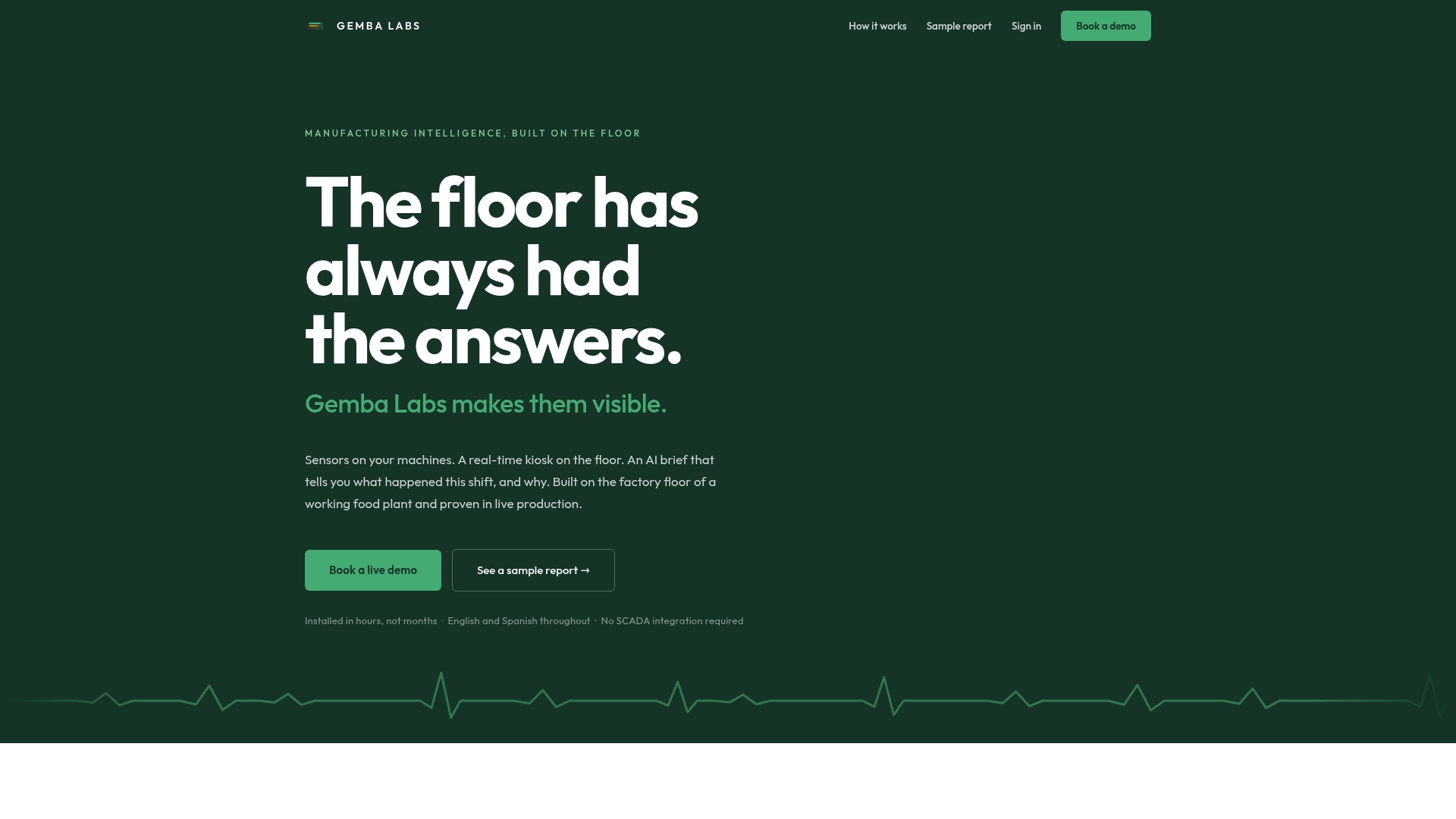
Gembalabs is sensor-based manufacturing intelligence software built for small and medium-sized food production facilities. It collects raw data from equipment cycles, combines it with operator input on downtime and rework, and uses AI to generate reports on shift performance, recurring issues, and production variance. The result is a clearer picture of facility performance than any MRP system provides on its own.
Where MRP tools tell you what was planned, Gembalabs tells you what happened and why. For food manufacturers dealing with equipment variability, shift-to-shift inconsistency, or recurring rework problems, that gap is where most of the recoverable cost sits. Gembalabs supports bilingual teams in English and Spanish, and it's designed to be deployed one facility at a time without a lengthy implementation project. It's not a replacement for an MRP system. It's what you add when your MRP tells you production ran, but doesn't tell you why it ran poorly.
Key Takeaways
The right Katana MRP alternative is the one that matches your actual business model, not the one with the longest feature list.
| Point | Details |
|---|---|
| Match tool to business model | Manufacturers need MRP depth; multi-channel sellers need marketplace sync. Buying the wrong category wastes budget. |
| MRPeasy is the closest swap | For production planning, BOMs, and scheduling, MRPeasy is the most direct like-for-like replacement for Katana. |
| Complex platforms cost more than listed | Cin7 Core starts at ~$349/mo and Unleashed at ~$399/mo; implementation and add-ons raise the real first-year cost. |
| APIs let you combine tools | Running a light MRP alongside a multi-channel inventory platform via API often costs less than a single enterprise ERP. |
| Gembalabs adds floor-level visibility | For food manufacturers, Gembalabs captures equipment and shift data that MRP systems don't track, surfacing variance and downtime in real time. |