
Batch vs continuous processing defines how raw ingredients become finished food products. Either you transform a fixed quantity at a time, or you run a constant flow from input to output without stopping. The choice shapes everything: production speed, regulatory traceability, capital requirements, and how well your facility handles recipe changes. FDA and FSA compliance requirements make this decision even more consequential, since batch genealogy systems directly determine your ability to execute a surgical recall without shutting down an entire line. AI is now changing what both methods can achieve, and understanding the trade-offs is the first step toward making the right call for your operation.
What are the core differences between batch and continuous processing?
Batch processing is defined as the production of a fixed, discrete quantity of product through a sequence of steps before the next quantity begins. A sauce manufacturer filling a steam jacketed kettle, cooking to temperature, holding, then discharging is running a classic batch production model. Each run is isolated, traceable, and independently adjustable. The next batch does not start until the current one is complete.
Continuous processing runs without interruption. Ingredients enter one end of a system and finished product exits the other, non-stop. Beverage lines, flour milling, and cooking oil refining are textbook continuous processing industries. The process does not pause between units of output because there are no discrete units. Product flows as a stream, not a batch.
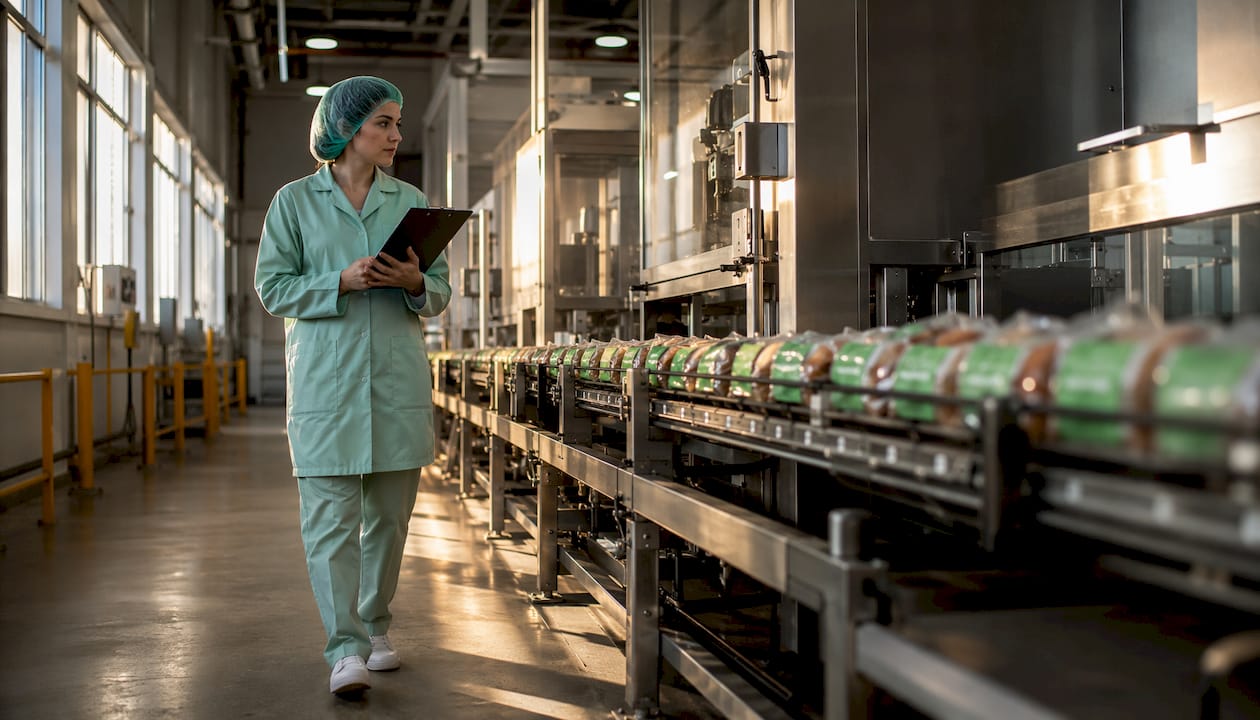
The operational contrast is sharp. Batch systems use general-purpose equipment that can handle multiple recipes. Continuous systems use dedicated lines built for one product or a narrow product family. Batch processing sits between job production and flow production, blending adaptability and scalability for fluctuating demand and product variants. Continuous lines sacrifice that flexibility for throughput.
How equipment design reflects method choice
Equipment tells you which method a facility is built around. Batch operations rely on vessels, tanks, mixers, and ovens that can be cleaned, recharged, and reprogrammed between runs. Continuous operations rely on conveyors, inline heat exchangers, and extruders that run at steady state. Changeover on a continuous line is expensive and time-consuming. Changeover on a batch line is the normal rhythm of production.
Pro Tip: When evaluating new equipment, check whether the vendor's cleaning-in-place (CIP) system is designed for full-stop or running-rinse cycles. That single design choice tells you which processing method the equipment was built to support.
What are the main advantages and disadvantages of each method?
The right method depends on your production volume, product variety, and capital position. Neither approach is universally superior.
Batch processing advantages
- Recipe flexibility. You can change formulations between runs without retooling the line. Specialty and small-scale production with recipe flexibility is where batch systems excel.
- Regulatory traceability. FDA and FSA require strict batch tracking. Batch processing enables selective recall without a full line shutdown, and audit-ready traceability is built into the method by design.
- Lower startup cost. Batch systems carry lower initial infrastructure costs than continuous lines. That makes them accessible for small and medium-sized manufacturers.
- Tighter manual control. Batch processing provides tighter control over formulations and easier adjustment of process parameters, including temperature holds and agitation speeds, between runs.
Continuous processing benefits
- Throughput. Continuous lines maximize output per hour for standardized products. High-volume, standardized food operations are where continuous processing delivers its strongest return.
- Uniformity. Steady-state operation produces consistent product quality across millions of units without the run-to-run variation that batch systems can introduce.
- Reduced labor per unit. Once running, continuous lines require less hands-on intervention per unit of output than batch operations.
- Energy efficiency at scale. Heating and cooling systems run at steady state, avoiding the energy spikes that come with repeated batch startup and shutdown cycles.
Comparing the trade-offs
| Factor | Batch processing | Continuous processing |
|---|---|---|
| Capital cost | Lower initial investment | High capital and complexity |
| Recipe flexibility | High, easy changeover | Low, dedicated to narrow product range |
| Regulatory traceability | Strong, built-in batch genealogy | Requires additional tracking systems |
| Throughput | Moderate, limited by cycle time | High, optimized for volume |
| Raw material consistency | Tolerates variability between runs | Requires consistent inputs |
| Maintenance demands | Moderate, per-batch wear | High, continuous uptime pressure |
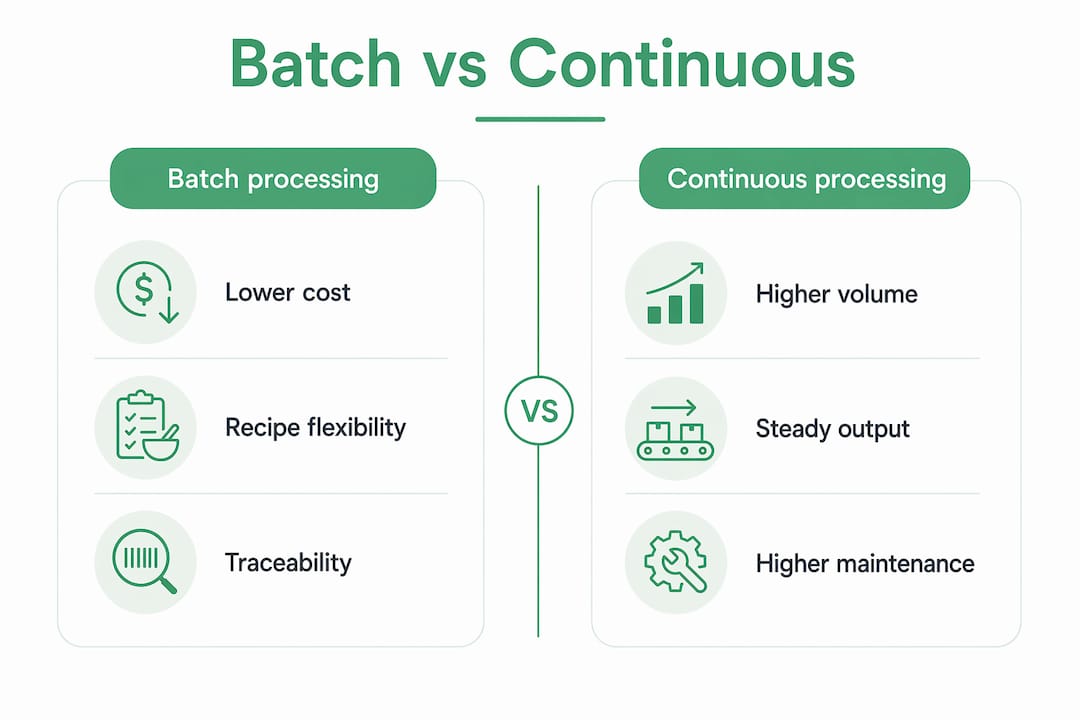
Continuous process lines deliver high asset utilization but increased operational maintenance demands. That maintenance burden is a real cost that does not always appear in capital expenditure comparisons.
Pro Tip: When calculating total cost of ownership for a continuous line, add at least 15% of capital cost annually for maintenance, spare parts, and unplanned downtime. Batch lines rarely carry that overhead at the same rate.
How is AI transforming batch processing in food manufacturing?
Traditional batch control systems run on fixed recipes: set the temperature, set the time, discharge when the timer ends. That approach works until it does not. Ingredient variability, seasonal raw material changes, and equipment wear all create drift that fixed programs cannot catch.
AI integration transforms batch control from rigid to adaptive. Advanced sensors feed real-time data into machine learning models that predict deviations and optimize recipes mid-run. The system does not wait for a quality failure. It detects the early signal and adjusts before the batch goes out of spec.
The practical benefits are measurable across several areas:
- Early deviation detection. AI-based sensors and analytics maintain consistent flavor, texture, and safety by catching recipe drift before it compounds into a quality failure.
- Predictive maintenance. Sensor data identifies equipment wear patterns before a breakdown stops production. That shifts maintenance from reactive to scheduled.
- Energy optimization. AI models identify the most efficient heating and cooling profiles for each recipe, reducing energy consumption per batch.
- Staff time recovery. Batch processing automation frees significant staff time by shifting heavy processing tasks to off-peak hours. Resource costs can drop measurably when manual monitoring is replaced by automated alerts.
The prerequisite for all of this is data readiness. AI cannot optimize what it cannot measure. Facilities that run on paper logs or disconnected spreadsheets cannot feed the sensor data that adaptive batch control requires.
Pro Tip: Before investing in AI-driven batch control, audit your current data capture. If your equipment cycles are not logged digitally and your downtime events are tracked on paper, start there. Gembalabs compiles raw equipment cycle data and human-reported events like downtime and rework into a single view, which is exactly the data foundation AI batch control needs.
When should you choose batch versus continuous processing?
The decision is not purely about volume. Speed is often mistakenly seen as the sole driver for continuous processing. Business decisions and product stability should dictate the choice.
Use batch processing when:
- Your product range is wide. If you produce 20 sauce varieties on one line, batch is the only practical method.
- Your volumes are moderate or variable. Batch handles demand fluctuations without waste. Continuous lines running below capacity are expensive.
- Your raw materials vary. Significant natural variance in ingredients challenges continuous lines without costly AI-driven real-time controls. Batch tolerates that variability run by run.
- Regulatory traceability is a priority. Batch genealogy gives you the audit trail that FDA and FSA inspectors expect.
Use continuous processing when:
- Your volume is high and stable. A single SKU produced at millions of units per week justifies the capital cost.
- Your inputs are consistent. Continuous lines perform best when raw material quality is tightly controlled and predictable.
- Your product does not change. Reformulation on a continuous line is a major engineering event. If your recipe is locked, that cost is irrelevant.
Most manufacturers start with batch processing to master product consistency before transitioning to continuous at higher volume with stable inputs. That staged approach reduces risk. Committing to a continuous line before you have stable recipes and reliable raw material supply is one of the most expensive mistakes a food manufacturer can make.
The hybrid approach is also worth considering. Some facilities run batch mixing and continuous forming or cooking. That combination captures batch flexibility in formulation and continuous efficiency in the high-throughput steps. It is not a compromise. For many product categories, it is the optimal design.
Key Takeaways
Batch processing is the right default for food manufacturers who need recipe flexibility and regulatory traceability, while continuous processing delivers its value only when volume, input consistency, and capital position all align.
| Point | Details |
|---|---|
| Method selection drives total cost | Capital, maintenance, and compliance costs differ sharply between batch and continuous lines. |
| Batch traceability is a regulatory asset | FDA and FSA batch tracking requirements favor batch genealogy for audit-ready recall management. |
| AI makes batch control adaptive | Predictive sensors and machine learning catch recipe drift before batches fail quality checks. |
| Raw material variability favors batch | Ingredient inconsistency challenges continuous lines without expensive real-time monitoring systems. |
| Most manufacturers start with batch | Achieving product consistency before scaling to continuous reduces investment risk significantly. |
The case for knowing your operation before choosing your method
Trevor here. After working with food manufacturers across a range of facility sizes, the pattern I see most often is not a wrong method choice. It is a method choice made without enough operational data to justify it.
I have watched facilities invest in continuous lines because a competitor had one, not because their volume or product stability warranted it. The maintenance burden alone ate the efficiency gains within 18 months. Batch processing gets dismissed as the "small operation" approach, but that framing is wrong. Batch is where you learn your product. It is where you build the recipe consistency that a continuous line demands as its baseline input.
The AI developments in batch control are genuinely exciting. Adaptive systems that detect fermentation drift or viscosity changes mid-run and correct without human intervention are not theoretical. They are running in facilities right now. But they require a data foundation that most SMEs have not built yet. The facilities winning with AI-enhanced batch control are the ones that digitized their equipment cycles and downtime events first, then layered intelligence on top.
My honest view: the batch versus continuous debate is less interesting than the question of how well you understand what is actually happening inside your current process. If you cannot answer why your last three batches had different yields, you are not ready to make a confident method decision. Get the data first.
— Trevor
How Gembalabs helps you track what your process is actually doing
Gembalabs is built for food manufacturers who need a clear picture of what their equipment and staff are producing, and where the gaps are. The platform pulls raw data from equipment cycles and combines it with human-reported events like downtime and rework, giving you a single, accurate view of your facility's performance. For batch operations, that means cycle-by-cycle visibility. For facilities evaluating a move to continuous, it means the production history you need to justify the investment.
Gembalabs also integrates with AI to generate reports on the specific questions you want answered, whether that is yield consistency across batches, equipment downtime patterns, or staff efficiency by shift. See how it works on the Gembalabs intelligence platform page, or visit Gembalabs to learn more about what the platform tracks.
FAQ
What is the main difference between batch and continuous processing?
Batch processing transforms a fixed quantity of product through sequential steps before the next quantity begins. Continuous processing runs without interruption, with ingredients entering and finished product exiting in a constant flow.
Which is better for regulatory compliance in food manufacturing?
Batch processing is better for regulatory compliance. FDA and FSA requirements favor batch genealogy systems that provide audit-ready traceability and enable selective recalls without shutting down an entire production line.
When does continuous processing make more sense than batch?
Continuous processing makes sense when production volume is high and stable, raw materials are consistent, and the product recipe does not change frequently. High capital cost makes it impractical for low-volume or highly variable product ranges.
How does AI improve batch processing performance?
AI integrates with sensors to detect recipe drift early, predict equipment maintenance needs, and adjust process parameters mid-run. This shifts batch control from fixed-program operation to adaptive, real-time quality management.
Can a facility use both batch and continuous methods?
Yes. Many food facilities run batch mixing with continuous forming or cooking. This hybrid approach captures recipe flexibility in formulation steps and throughput efficiency in high-volume production steps.