For small and medium-sized food manufacturers, the best food traceability software combines sensor-driven equipment monitoring, operator input capture, and AI-assisted reporting in a single system. Gembalabs is built precisely for this: it pulls raw data from equipment cycles, collects shift-level personnel inputs, and generates AI reports on downtime, rework, and recurring issues, all without requiring an enterprise IT team to run it.
- Real-time visibility: Live equipment telemetry plus operator logs give you a single source of truth for every production event, which is what FSMA 204 and fast recall response both demand.
- Pilot-first deployment: Gembalabs typically starts with one production cell or line, so you see measurable results before committing to a full rollout.
Table of Contents
- Why does real-time traceability matter for SMB food manufacturers?
- What should you look for in food tracking software?
- How does Gembalabs address these needs?
- How do you run a pilot and roll out traceability at your plant?
- What ROI and operational improvements can you realistically expect?
- What questions should you ask vendors, and how do you judge pilot success?
- Key Takeaways
- What most people get wrong about traceability software
- Ready to see what Gembalabs can do for your plant?
- Useful sources
Why does real-time traceability matter for SMB food manufacturers?
Paper logs have one fatal flaw: they are always behind. By the time a supervisor transcribes a downtime event or a rework batch, the window to catch the root cause has closed. Switching to digital traceability is the single most effective step toward FSMA 204 readiness, because manual records rarely carry the detail or timestamp precision that rapid recall response requires.
The regulatory pressure is real. FSMA 204 requires food manufacturers handling high-risk foods to capture Critical Tracking Events (CTEs) and Key Data Elements (KDEs) with enough detail to share them with FDA on short notice. Digital logs satisfy that requirement automatically; paper logs often do not.
The operational upside goes beyond compliance. Platforms that store traceability data in harmonized formats can run forward and backward traces in a single query, cutting recall investigation time from many hours to minutes.
Manufacturers who treat traceability as business intelligence, not just a compliance checkbox, gain something more useful: real-time insight into production bottlenecks, rework rates, and equipment downtime that traditional systems miss entirely.
What should you look for in food tracking software?
The features that matter most for an SMB plant are not the same ones that matter for a 10-facility enterprise. Keep this list in front of you during every vendor demo.
Core capabilities:
- Real-time equipment telemetry: cycle counts, run rates, downtime events, and alerts
- Operator input capture with bilingual (English/Spanish) UI and shift-log workflows
- Lot and batch forward/backward tracing, ideally in a single query
- AI-assisted reports covering downtime, rework, shift summaries, and recurring issues
- FSMA 204-compliant export formats (Electronic Sortable Spreadsheets, GS1/CTE alignment)
Integration requirements:
- Sensor and PLC adapters for your existing equipment
- ERP/MES connectors or CSV import/export as a fallback
- Barcode and lot-number capture at operator touchpoints
- Mobile-friendly operator interfaces for on-floor use
Procurement criteria:
- Pilot availability before full subscription commitment
- Subscription pricing per facility or per sensor, not opaque enterprise quotes
- Defined support SLAs and bilingual training materials
- Realistic time-to-value: most SMB pilots should show meaningful data within a few weeks
Pro Tip: Most SMBs underweight data harmonization during vendor selection. If your sensor data, operator logs, and ERP events don't map to a consistent product and batch identity, you end up with fractured traces that fail exactly when you need them most, during a recall.
How does Gembalabs address these needs?
Gembalabs maps directly to the criteria above. Here is how the feature set lines up for a typical SMB plant:
| Criterion | How Gembalabs handles it |
|---|---|
| Real-time equipment monitoring | Sensor-based data capture: cycle counts, downtime events, run-rate trends updated continuously |
| Operator input and shift logs | On-floor input collection with bilingual English/Spanish support for operators and supervisors |
| AI-assisted reporting | AI generates targeted reports on downtime, rework, shift results, and recurring issues on demand |
| FSMA 204 readiness | Digital event logs with audit trail; exportable records aligned to CTE/KDE requirements |
| Integration | PLC/sensor adapters, ERP/MES connectors, barcode and lot-data capture |
| Data security | Structured data storage with user access controls and full audit trail |
| Pilot model | One production cell or line to start; typical SMB pilot runs a few weeks |
What a pilot looks like in practice:
- Gembalabs scopes the pilot to one product line or production cell, limiting disruption.
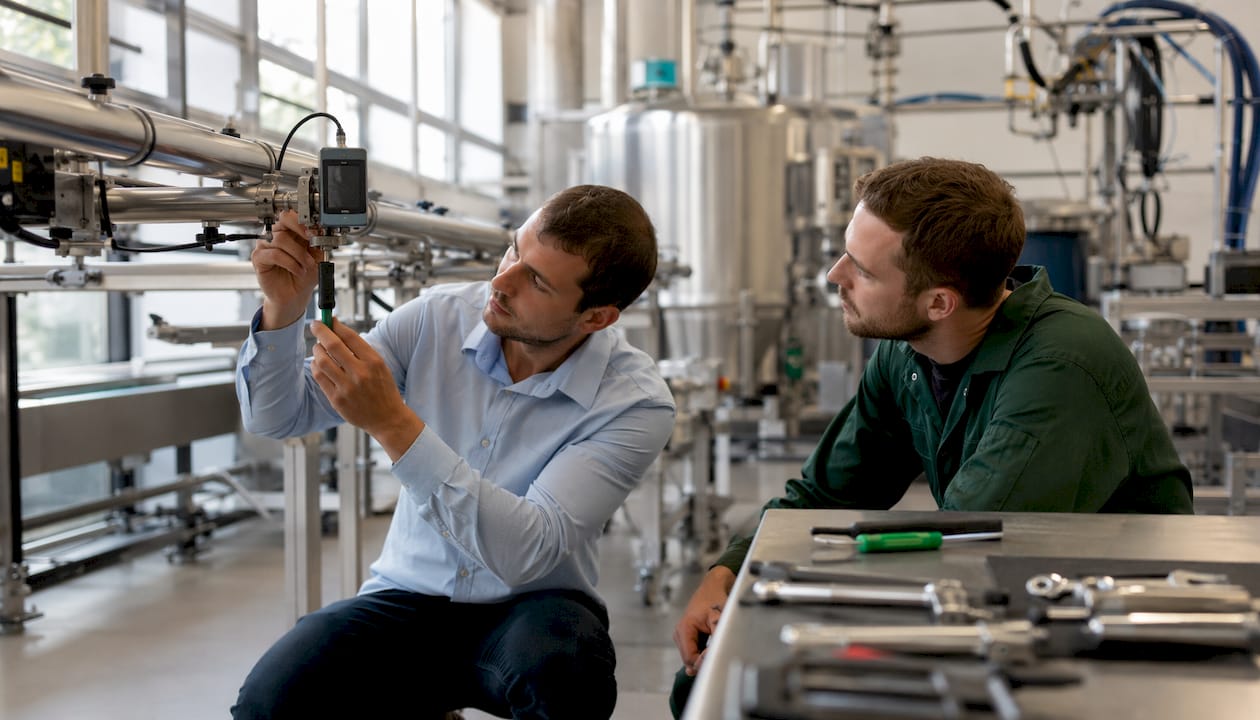
- Sensors are installed and mapped to your existing equipment identifiers and lot numbers.
- Operators are trained in English and Spanish before the pilot run begins.
- By the end of the pilot, you have a baseline for downtime frequency, rework rate, and trace time for affected lots.
The product intelligence page walks through the full sensor-to-report workflow if you want the technical detail before a conversation.
How do you run a pilot and roll out traceability at your plant?
Start narrow. Picking one production cell rather than the whole floor is not timidity; it is how you get clean data fast and build internal buy-in before scaling.
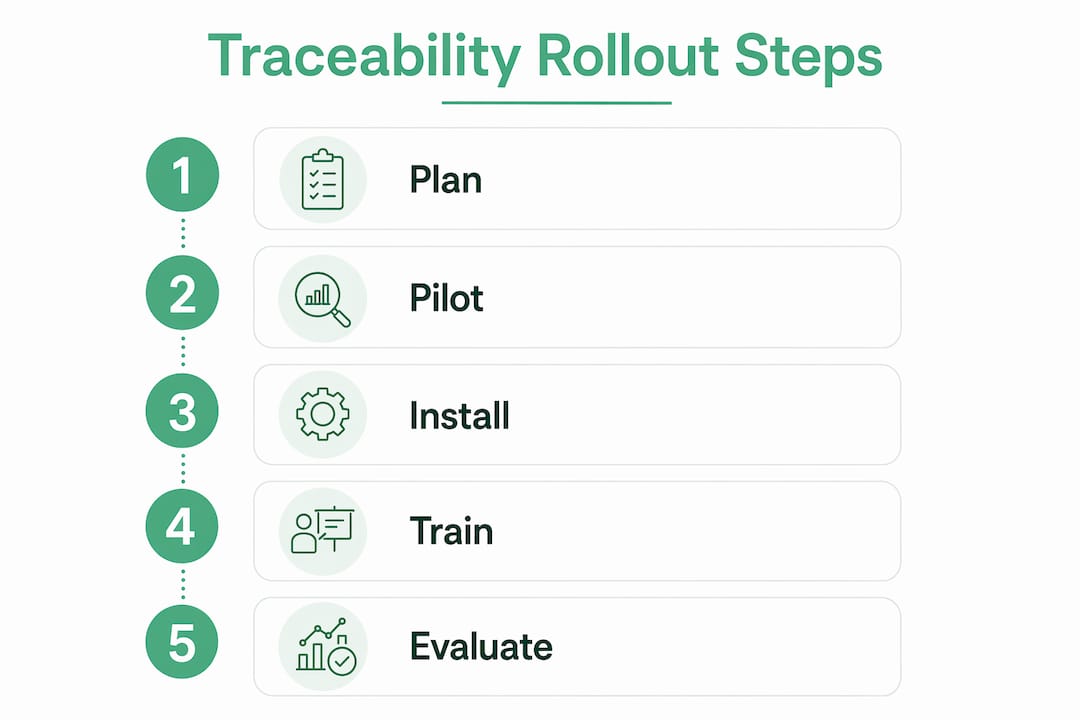
Typical pilot phases:
| Phase | Activities | Duration |
|---|---|---|
| Planning and scoping | Select cell, map sensors, identify integrations | 1–2 weeks |
| Sensor install and config | Hardware placement, PLC connections, lot-ID mapping | 1–2 weeks |
| Operator training | Bilingual onboarding, input workflow walkthrough | 3–5 days |
| Data validation | Verify sensor reads, operator log completeness, lot linkage | 1 week |
| Pilot run | Live production with full data capture | 2–4 weeks |
| Evaluation | Review KPIs, run mock recall drill, assess FSMA 204 export | 3–5 days |
Pilot acceptance checklist:
- Sensor data completeness above 95% of production cycles captured
- Operator log compliance rate above 90% of required shift entries
- Forward and backward lot trace completed in under 15 minutes during mock recall
- FSMA 204 export generated and validated against CTE/KDE requirements
- AI report reviewed by plant manager and flagged issues confirmed against floor records
For guidance on scoping by process type, the batch vs. continuous processing guide helps clarify which production cells are best suited for a first pilot.
What ROI and operational improvements can you realistically expect?
The returns from real-time food traceability come from three places: less unplanned downtime, lower rework costs, and faster recall response.
During a recall, speed is the primary metric. The difference between a manageable incident and a weeks-long crisis is the ability to run forward and backward traces in a single query rather than hunting through paper binders.
A simple ROI calculation covers the basics:
ROI inputs to measure:
- Labor hours saved per week on manual log entry and report compilation
- Downtime minutes recovered per shift after equipment alerts are acted on
- Rework batches avoided per month once recurring issues are identified in AI reports
- Estimated cost of a recall investigation before and after digital traceability
Metrics to track from day one of your pilot:
- MTTD/MTTR: Mean time to detect and mean time to resolve equipment issues
- Operator compliance rate: Percentage of required shift logs completed on time
- Lot isolation time: Minutes to identify and isolate affected lots in a mock recall
- Rework rate: Percentage of production requiring rework per shift or per batch
Manufacturers who use real-time telemetry combined with operator inputs consistently find bottlenecks that traditional traceability systems never surface, because those systems capture what happened but not why or when the first signal appeared.
What questions should you ask vendors, and how do you judge pilot success?
Bring these to every vendor demo. The answers separate platforms built for SMB plants from enterprise tools retrofitted to look affordable.
Essential vendor questions:
- What is your typical deployment timeline for a single-facility SMB pilot?
- Who owns the data, and can we export everything in a standard format if we leave?
- Do you support FSMA 204 Electronic Sortable Spreadsheet exports natively?
- How do you connect to our existing PLCs and sensors, and what hardware do you supply?
- What does your offline or low-connectivity workflow look like for floor operators?
- Is bilingual (English/Spanish) training included, or is it an add-on?
- What are your support SLAs, and who handles issues during a production shift?
- What security certifications do you hold, and how is audit-trail data stored?
Red flags to watch for:
- Data stored in siloed formats with no standard export path
- No on-floor operator workflow; the system assumes desk-based data entry
- Vague answers about FSMA 204 compliance ("we're working on it")
- Pricing that requires a multi-year contract before you've seen a single pilot result
Pilot acceptance criteria:
- Trace time for a mock recall under 15 minutes, end to end
- Sensor data completeness above 95%
- Operator adoption above 90% of required entries
- At least one AI-generated report reviewed and validated by plant management
- FSMA 204 export tested and confirmed against FDA format requirements
Key Takeaways
Real-time food traceability software that combines equipment monitoring, operator input, and AI reporting delivers both FSMA 204 readiness and measurable operational ROI for SMB food manufacturers.
| Point | Details |
|---|---|
| Digital over paper | Switching to digital traceability is the fastest path to FSMA 204 readiness and faster recall response. |
| Single source of truth | Harmonized sensor, operator, and lot data prevents fractured traces during recalls and audits. |
| Pilot before full rollout | Start with one production cell to validate data quality and operator adoption before scaling. |
| Measure from day one | Track MTTD/MTTR, lot isolation time, rework rate, and operator compliance rate during the pilot. |
| Gembalabs for SMBs | Gembalabs combines sensor-based equipment monitoring, bilingual operator input, and AI reporting in a pilot-first model built for SMB food plants. |
What most people get wrong about traceability software
The conventional framing treats traceability as a compliance cost. Buy the software, check the FSMA 204 box, move on. That framing explains why so many SMB plants end up with systems their operators barely use and their managers never look at between audits.
The plants that actually get value from food quality management systems treat the data as a production tool first. When your equipment telemetry and operator logs feed the same system, you stop asking "what happened during that shift?" after the fact and start catching the pattern three shifts before it becomes a rework event. That is a fundamentally different relationship with your own floor data.
The bilingual support point is also underrated. A system that operators trust and actually use in their preferred language produces better data than a technically superior platform that gets gamed or ignored because the interface is confusing. Adoption is a feature.
Ready to see what Gembalabs can do for your plant?
Most SMB food manufacturers are one pilot away from knowing exactly where their downtime and rework are coming from. Gembalabs gives you sensor-level equipment data, operator shift logs in English and Spanish, and AI-generated reports that flag recurring issues before they compound. No enterprise IT team required, no multi-year contract before you've seen results.
Here is how a pilot works: request a demo, scope one production cell with the Gembalabs team, complete sensor installation and operator training (typically two to three weeks), then run a live pilot for 30–60 days. By the end, you have a real baseline on downtime, rework, and lot trace time, not a vendor's promise.
Visit the Gembalabs intelligence page for the full feature walkthrough, or go directly to gembalabs.io to request a pilot conversation. Bilingual support is included from day one.
Useful sources
- FSMA 204 Traceability Compliance Guide — Gembalabs Blog: Covers FSMA 204 recordkeeping requirements, CTE/KDE definitions, and export format readiness steps for food manufacturers.
- TradeEdge Traceability — Edgeverve: Industry guidance on digitizing CTEs, harmonized data ingestion, and reducing recall investigation time through structured event stores.
- Kezzler Traceability: Practitioner perspective on single-source-of-truth architectures and standards-compliant event data for faster, interoperable traces.
- TraceFood Platform: Implementation-level detail on batch-level QR codes, real-time analytics, and single-query forward/backward trace capability.
- FoodLogiQ Traceability — Trustwell: Feature reference for CTE investigation UIs, GS1 alignment, and FSMA 204 Electronic Sortable Spreadsheet exports.
- Real-Time Equipment Monitoring for Food Manufacturers — Gembalabs Blog: Deep dive on equipment telemetry, cycle counts, downtime metrics, and on-floor sensor integrations.