Paperless food manufacturing replaces paper logs with digital, audit-ready records and real-time process control. The fastest path: run a focused pilot on one line, one shift, one product, then expand once you have auditor-equivalent evidence in hand. Follow this sequence: assess your current paper load and CCP gaps (2–4 weeks), run a sensor-first pilot with digital batch records and electronic work instructions (8–12 weeks), validate against your audit scheme, then roll out quarterly by line. For SME food plants evaluating a vendor, Gembalabs' sensor-first MES is the recommended starting point.
- Assess: Map every paper form touching a CCP, batch record, or sanitation log.
- Pilot: Connect sensors to 1 line, enforce digital gates at your top 2–3 CCPs, run parallel paper alongside digital for a full audit cycle.
- Validate: Confirm auditor equivalence, test evidence retrieval, get sign-off.
- Scale: Roll out one line per quarter with a trained operator cohort.
Key Takeaways
Paperless food manufacturing pays off fastest when you start with a sensor-first pilot on one line, enforce digital gates at your top CCPs, and validate against your audit scheme before scaling.
| Point | Details |
|---|---|
| Start narrow, then scale | Pilot on one line, one product, one shift before expanding to avoid change-management failure. |
| Audit prep savings are measurable | Digital systems can cut audit-prep time by several days per cycle, a direct labor saving. |
| 21 CFR Part 11 is non-optional | Any U.S. food plant using electronic records must meet FDA's Part 11 access, signature, and audit trail requirements. |
| Parallel run protects compliance | Run paper and digital simultaneously for one full audit cycle before switching to digital-only. |
| Gembalabs fits SME plants | Gembalabs' sensor-first MES connects equipment data and operator input to produce AI-generated, audit-ready reports for small and mid-sized food facilities. |
Table of Contents
- What does "paperless manufacturing" actually mean in a food plant?
- Why paperless food manufacturing pays off faster than most plants expect
- Which factory processes should you digitize first?
- What core features should you require from a paperless system?
- How to implement a paperless system: the four-phase roadmap
- How should you architect your IT/OT/IoT data flows?
- What people problems will derail your paperless rollout?
- What does a sensor-first MES pilot actually look like?
- What do FDA, FSMA, and scheme certifications require from a digital system?
- What does a paperless transition actually cost, and what ROI should you expect?
- The part of this conversation most operations leaders skip
- Gembalabs gives SME food plants a sensor-first path to audit-ready records
- Sources
What does "paperless manufacturing" actually mean in a food plant?
The industry term is electronic manufacturing execution, and in a food context it means replacing every paper-based production record with a digital equivalent that carries a time-stamp, a user identity, and an unbroken audit trail. That covers electronic batch records (EBRs), digital work instructions with enforced completion gates, IoT sensor feeds tied directly to critical control point (CCP) logs, and supplier traceability documents captured at goods receipt.
What it does not mean: scanning paper and filing PDFs. That is digitization of paper, not a paperless system. Auditors under FSMA and HACCP schemes distinguish between the two quickly.
The scope of a genuine paperless transition includes batch records, CCP monitoring logs, sanitation and CIP records, equipment calibration certificates, operator training acknowledgments, and supplier certificates of analysis. Some legal originals and archived physical certificates may still need a paper copy depending on your scheme, but the working record used on the floor should be digital.
Unit-level traceability is where auditors focus most. They want to see that a specific lot of raw material can be traced forward to every finished unit it touched, and that every CCP reading for that lot is time-stamped and tied to a named operator. A paper binder cannot do that reliably at speed. A well-configured EBR can pull that evidence in minutes.
Why paperless food manufacturing pays off faster than most plants expect
The compliance case is the easiest to quantify. Digital audit systems can cut audit-prep time by several days in real-world plant examples, and the same digital records that speed up prep also narrow recall scope because lot-level traceability is already structured. A paper-based plant doing a recall traces lots manually; a digital plant queries a database.
Operational benefits are just as concrete:
- Fewer transcription errors on batch records, which directly reduces rework and first-pass yield losses.
- Faster shift handovers because the outgoing shift's data is already captured and visible to the incoming lead.
- Improved OEE through real-time downtime capture: operators log the reason at the machine, not from memory at end of shift.
- Consistent CCP control because digital work instructions can lock the next step until the operator confirms a reading is in range.
AIB International confirms that moving to a paperless factory improves food safety, though they stress that third-party support is needed to keep digital processes compliant and auditable. That point matters: technology alone does not close a compliance gap; the process design behind it does.
Sustainability note: Reducing on-site paper consumption lowers both procurement cost and the environmental load tied to paper production. For plants pursuing eco-friendly food manufacturing credentials or ESG reporting, documented paper reduction is a measurable, auditable metric.
The business case compounds when you factor in recall response. A narrower recall scope means fewer units pulled, lower write-off costs, and faster FDA notification. Plants that have structured lot-level traceability in a digital system consistently report faster response times than those reconstructing paper trails under pressure.
Which factory processes should you digitize first?
Sequence matters. Start where the audit risk and rework cost are highest, not where digitization is easiest.
- Digital batch records and CCP logs. Every HACCP plan has critical limits. Digitizing these first gives you the highest compliance return and the clearest before/after comparison for auditors. Gate the next process step on a confirmed in-range reading.
- Digital work instructions. Paper SOPs get ignored, revised informally, or used in the wrong version. Digital work instructions with version control and completion locks eliminate that. Link them to standard work practices to reinforce consistency across shifts.
- QC and inspection logs, including image capture. Defect images attached to a lot record are far more useful in a recall or customer complaint than a handwritten tally. Mobile capture at the line is the fastest way to get this running.
- Sanitation and CIP logs. These are high-frequency, high-consequence records. Digital capture with time-stamps and operator sign-off removes the "did we actually do it?" ambiguity that auditors probe.
- Preventive maintenance records. Equipment downtime tied to missed PM tasks is a common OEE leak. Digital PM scheduling with completion confirmation closes the loop between maintenance and production.
- Supplier and traceability records. Goods-receipt lot capture via barcode or QR, linked to the supplier's certificate of analysis, completes the traceability chain from raw material to finished unit. Practical guidance on food traceability software can help you structure this step.
What core features should you require from a paperless system?
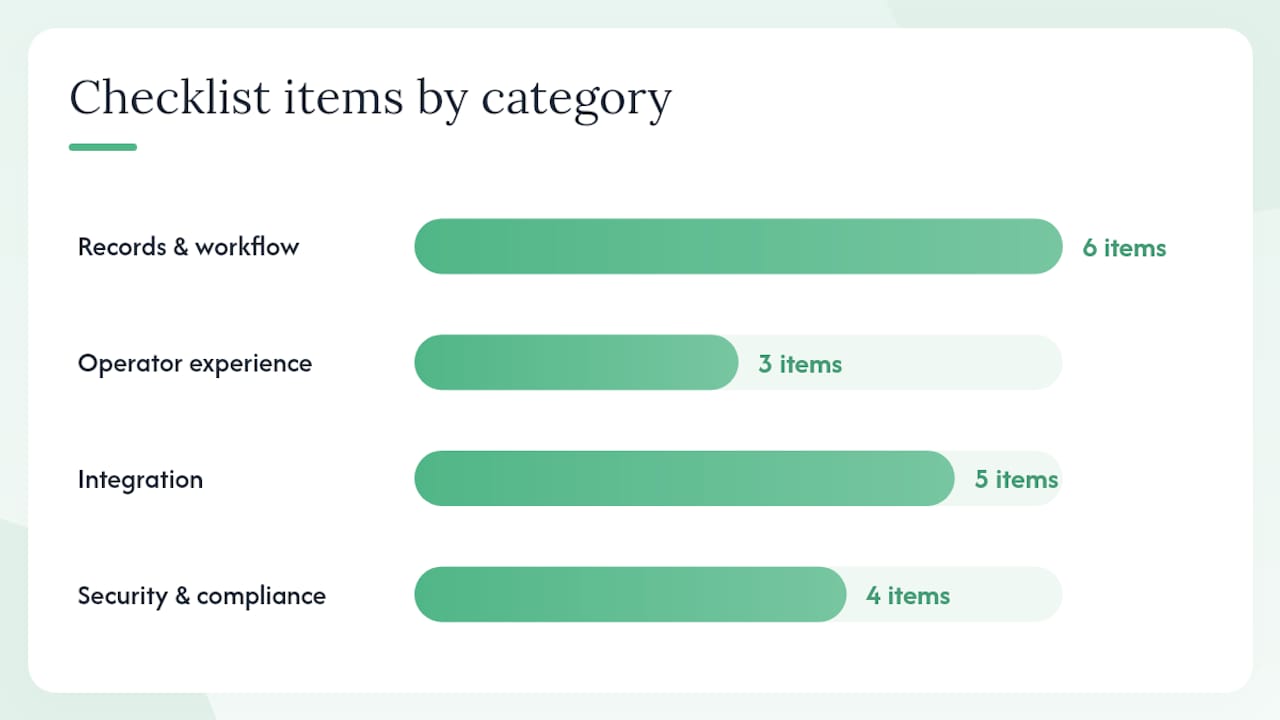
This is your vendor evaluation checklist. Any system that cannot check every box below is not ready for a regulated food plant.
Records and workflow:
- Electronic batch records with structured data fields (not free-text notes)
- Digital work instructions with enforced completion gates and version control
- Role-based electronic signatures with time-stamps and audit trails
- Image and document attachments at the lot or step level
- CAPA and deviation workflow tracking
- Recipe and formula version control with change history
Operator experience:
- Operator prompts that guide step-by-step without requiring IT literacy
- Bilingual support (English and Spanish at minimum for most U.S. plants)
- Mobile or tablet interface that works in a washdown environment
Integration:
- PLC connectivity via OPC-UA or Modbus for direct sensor data ingestion
- ERP/MRP integration for SKU master data and purchase-order lot capture
- Barcode and QR lot scanning at goods receipt and line start
- IoT sensor ingestion with edge compute for low-latency CCP monitoring
- MES compatibility if you are layering on top of an existing system
Security and compliance:
- 21 CFR Part 11 capabilities: unique user IDs, audit trails, system access controls, and electronic signature meaning statements
- Encryption at rest and in transit
- Automated backups with configurable retention periods
- Validation documentation package (IQ/OQ/PQ or equivalent) available from the vendor
Pro Tip: Ask every vendor for a sample 21 CFR Part 11 gap assessment against their own system. A vendor who cannot produce one has not done the work — and that gap becomes your compliance problem, not theirs.
Rockwell Automation's guidance frames the core value of a paperless strategy as building a unified OT/IT data foundation. A system that cannot connect your shop-floor sensors to your quality records is not a paperless system; it is another silo. For a deeper look at MES selection criteria for SME food plants, the feature priorities above translate directly into RFP language.
How to implement a paperless system: the four-phase roadmap
| Phase | Duration | Key Activities |
|---|---|---|
| Assessment | 2–4 weeks | Map all paper forms, identify CCP gaps, confirm sensor readiness, select pilot line |
| Pilot | several weeks | Deploy sensors, configure EBR and digital work instructions, run parallel paper, train operators |
| Validation | One audit cycle | Auditor-equivalence review, test evidence retrieval, sign-off on digital-only records |
| Scale | Quarterly rollouts | Add one line per quarter, train-the-trainer, expand integrations |
Pilot checklist before go-live:
- Equipment mapping complete: every sensor point on the pilot line identified and tagged.
- Sensor readiness confirmed: PLC connectivity tested, data flowing to the MES.
- Operator training complete: minimum 4 hours per operator on the new interface.
- Data acceptance criteria defined: completeness target, error threshold, response-time benchmark.
- Parallel run strategy agreed: paper and digital run simultaneously for the first audit cycle.
- Change control documented: who approves recipe changes, who can override a gate, and how deviations are logged.
Sample ROI calculation: A 200-person food plant spending 5 days preparing for each annual audit, at a fully loaded cost of $800 per person-day for the QA team, spends roughly $4,000 per audit cycle in prep labor alone. Cutting that by 4 days (a figure consistent with reported digital audit savings) saves $3,200 per audit. Add one avoided rework batch per month at $2,500 in materials and labor, and the annual saving exceeds $33,000 before counting recall-scope reduction. For most SME plants, that math justifies the pilot investment in under 12 months.
How should you architect your IT/OT/IoT data flows?
The architecture question most SME plants get wrong: they try to connect everything at once. The practical sequence is edge first, then aggregate, then analyze.
Data flow from floor to insight:
- Edge devices (PLCs, sensors, scales, temperature probes) capture raw process data at the machine.
- Edge gateway aggregates device data locally, buffers it during connectivity gaps, and forwards to the cloud or on-premise server.
- Time-series store holds raw sensor readings with millisecond timestamps for CCP evidence and trend analysis.
- MES/EBR layer is the system of record for batch execution: it ties sensor readings to lot numbers, operator IDs, and recipe versions.
- Analytics/AI layer sits on top, generating shift summaries, flagging anomalies, and producing the audit-ready reports your QA team actually reads.
System of record decisions to make early:
- ERP owns SKU master data and purchase-order lot numbers.
- MES/EBR owns batch execution records and is the audit record.
- The analytics layer reads from both but writes to neither.
Keeping those boundaries clean prevents the most common data-integrity failure: the same lot number appearing with different values in two systems.
Data retention, security, and backup:
- Retain electronic batch records for the longer of your scheme requirement or FDA expectation (typically 2 years minimum for most food categories, longer for infant formula and dietary supplements).
- Encrypt data at rest (AES-256 or equivalent) and in transit (TLS 1.2 minimum).
- Role-based access: operators see their line's records; QA sees all; IT administers but cannot alter production records.
- Daily automated backups with off-site or cloud redundancy; test restore quarterly.
A 2025 Frontiers review on digital twins shows that process-level simulation built on this kind of unified data foundation can optimize energy, water, and quality outcomes in food processing. That is the next-level application once your data architecture is solid. For a practical guide to IoT deployment patterns for SME food plants, the edge-first approach above maps directly to sensor selection and network design.
What people problems will derail your paperless rollout?
Technology rarely fails a paperless program. People and process do.
Adoption checklist:
- Involve operators in screen and workflow design before development is locked.
- Provide bilingual instructions from day one; do not treat Spanish-language support as a phase-two item.
- Run train-the-trainer: two or three operators per shift who become the floor experts, not just IT contacts.
- Tie performance incentives to data quality, not just throughput.
- Establish a governance model: who owns the system, who approves changes, and how deviations are escalated.
The seven pitfalls that kill paperless programs, and how to avoid them:
- Poor data quality at source. Garbage in, garbage out. Define field-level validation rules before go-live; do not let free-text fields replace structured data.
- Over-automation too early. Automating a broken process produces broken data faster. Fix the process first, then automate.
- Weak integration between systems. A QA system that cannot talk to the ERP creates manual re-entry, which recreates the paper problem digitally. Confirm integration scope in the vendor contract.
- Skipping validation. Auditors expect documented evidence that the system does what it claims. An undocumented system is an audit finding waiting to happen.
- No parallel run. Switching to digital-only before running one full audit cycle in parallel is the single fastest way to create a compliance gap. Practitioners recommend running parallel paper and digital through at least one audit cycle before going digital-only.
- Weak change control. Recipe changes, CCP limit updates, and work instruction revisions need an approval workflow. Without one, version drift becomes a food-safety risk.
- Unrealistic timelines. An 8–12 week pilot is realistic for one line. Expecting plant-wide deployment in 90 days is not. Compress the timeline and you compress the training, which collapses adoption.
What does a sensor-first MES pilot actually look like?
A practical pilot at a mid-sized sauce manufacturer illustrates the pattern. The scope: one filling line, one SKU, a four-week data-collection phase followed by an eight-week active pilot.
Before the pilot: QA staff spent roughly two days pulling paper records for each internal audit. Rework on the filling line ran at a rate that triggered a monthly review meeting. Downtime reasons were reconstructed from memory at end of shift, making root-cause analysis unreliable.
Pilot setup: Sensors were connected to the filler and capper via Modbus. Barcode scanners captured lot numbers at line start. Operators used tablets to confirm digital work instructions at each step, with a gate that required a CCP temperature confirmation before the batch could advance. Bilingual prompts (English and Spanish) were configured for the operator interface. Training ran four hours per operator across two shifts.
After eight weeks:
Digital records cut internal audit prep from two days to under four hours on the pilot line. Downtime reasons were captured in real time, which identified a recurring seal-failure pattern that had been invisible in the paper logs. Rework on the pilot line dropped measurably within the first month once operators could see their own shift data.
Validation steps the pilot passed: user requirements specification reviewed against actual system behavior, functional test scripts executed and logged, and a mock audit conducted by the QA lead using only digital evidence. The auditor-equivalence review confirmed the digital records met the evidentiary standard for the plant's BRC scheme.
This pattern, sensor-first, gated CCPs, parallel run, then validation, is the same sequence AIB International recommends for a compliant paperless transition.
What do FDA, FSMA, and scheme certifications require from a digital system?
Regulatory compliance checklist:
- 21 CFR Part 11: Unique user IDs, time-stamped audit trails, electronic signature meaning statements, system access controls, and the ability to generate accurate copies of records for FDA inspection. The FDA's Part 11 guidance outlines scope and application criteria in detail.
- FSMA traceability: Key Data Elements (KDEs) and Critical Tracking Events (CTEs) must be captured and retrievable within 24 hours of an FDA request under the Food Traceability Rule. Digital systems that structure lot data at goods receipt, processing, and shipping satisfy this requirement; paper systems rarely do.
- HACCP/BRC/FSSC 22000: Electronic records are accepted as equivalent to paper when the system maintains data integrity, prevents unauthorized alteration, and produces a complete audit trail. Scheme auditors will test your ability to retrieve a specific batch record on demand.
Minimum validation steps auditors expect:
- User Requirements Specification (URS) documenting what the system must do.
- Functional Specification confirming how the system meets each requirement.
- Test scripts with pass/fail criteria for each critical function.
- Traceable test evidence: screenshots, logs, or printouts showing tests were executed.
- Change control procedure for any post-validation modification.
Digital evidence shortens audit cycles because retrieving a specific batch record takes seconds rather than the 20–30 minutes a paper search typically requires. That speed difference is not just convenient; it changes the tone of an audit. An auditor who gets clean, complete records quickly has less reason to probe further.
What does a paperless transition actually cost, and what ROI should you expect?
Cost varies by plant size, existing infrastructure, and how much integration work is needed. For an SME food plant with one to three lines, the main cost categories are software subscription, hardware (sensors, tablets, edge gateway), integration development, and internal labor for validation and training.
Software subscriptions for SME-focused MES platforms typically run on a per-line or per-facility basis. Hardware costs depend on how many sensor points the pilot line requires and whether existing PLCs can be connected without new I/O modules. Integration development is the most variable cost: a plant with a modern ERP and OPC-UA-capable PLCs will spend far less than one running legacy equipment with no network connectivity.
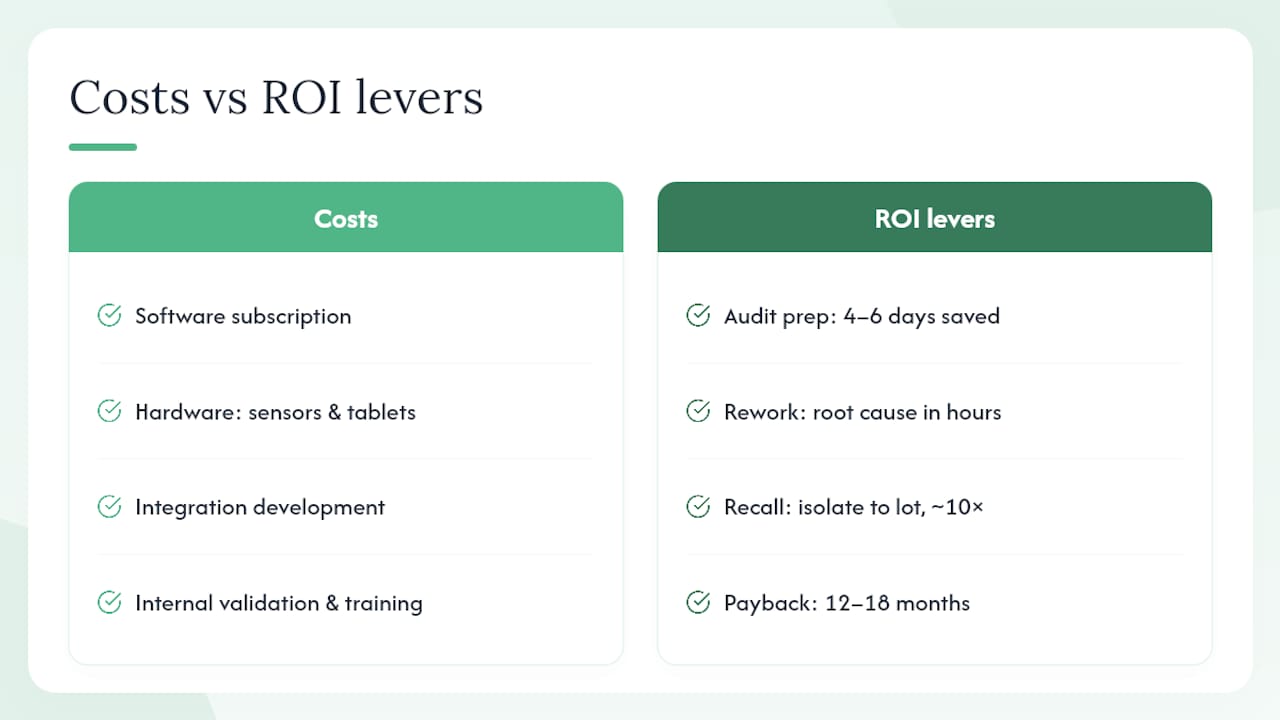
The ROI case has three reliable levers. First, audit prep labor: the 4–6 day reduction in prep time reported by plants using digital audit systems translates directly to QA staff hours redirected to prevention rather than paperwork. Second, rework reduction: structured batch data makes the root cause of a rework event visible in hours rather than days, which shortens the correction cycle. Third, recall scope: a plant with unit-level digital traceability can isolate a recall to a specific lot rather than a production day or week, which can reduce the volume of product pulled by an order of magnitude in a real event.
A reasonable payback target for an SME pilot is 12–18 months when all three levers are counted. Plants that count only audit prep savings often see payback in under a year. The key is measuring the baseline before the pilot starts, so the comparison is credible when you present it to ownership.
The part of this conversation most operations leaders skip
Most paperless programs fail in the first 90 days not because the technology is wrong but because the pilot scope was too wide. A plant manager who tries to digitize every form on every line simultaneously is not running a pilot; they are running a crisis. The technology becomes the scapegoat for what is actually a change-management failure.
The sensor-first approach works because it produces evidence before it asks for trust. When operators can see their own shift data on a screen at line end, and when that data matches what they know happened, they stop treating the system as surveillance and start treating it as a tool. That shift in perception is what makes scale possible.
There is also a compliance trap that catches well-intentioned teams: they go digital-only too fast. Running parallel paper and digital for one full audit cycle feels redundant, but it is the only way to confirm that your digital records satisfy an auditor who has never seen your system before. Skip that step and you are betting your next audit on an untested assumption.
The plants that get this right share one habit: they define what "done" looks like before the pilot starts. Not "we deployed the software," but "our auditor reviewed the digital records and confirmed equivalence." That is the proof point that justifies the next line, the next quarter, and the budget for full-scale rollout.
Gembalabs gives SME food plants a sensor-first path to audit-ready records
Most paperless programs stall because the gap between shop-floor sensors and audit-ready records requires custom integration work that SME plants cannot staff. Gembalabs closes that gap directly. The platform connects to your equipment via PLC and sensor feeds, collects operator input in real time, and uses AI to generate shift-level intelligence reports covering downtime, rework, recurring issues, and performance trends, in both English and Spanish.
A Gembalabs pilot is scoped to one line, one product, and runs in 8–12 weeks. Deliverables include real-time equipment monitoring, structured batch data, and AI-generated reports your QA team can use immediately. No months-long implementation, no enterprise contract. See how Gembalabs works and request a tailored assessment for your facility.
Sources
These primary sources provide the regulatory and technical depth behind the guidance in this article.
- Fda
- How Transitioning to a Paperless Factory Improves Food Safety
- Digital Twin applications in the food industry: a review
- Paperless HACCP, BRC and FSSC Audits: 2026 Guide for Food Plants | CondorVision