
The simplest repeatable shift handover process is a scheduled, paid overlap of a duration recommended for the team size and complexity that combines a structured written or digital record, a face-to-face review, and incoming-person verification before the outgoing team leaves. When all three elements are present, responsibility transfers cleanly. When any one is missing, the incoming shift inherits ambiguity instead of ownership.
The three-phase model from the UK Health and Safety Executive (HSE) defines those three elements as preparation by the outgoing team, a two-way exchange of task-relevant information, and cross-checking by the incoming team as it assumes responsibility. Marsh Risk Engineering's position paper reinforces this with specific time guidance: 10–15 minutes for field and panel operators and up to 30 minutes for area team leaders and shift managers. Both sources treat the handover as a formal, uninterrupted work event, not a hallway conversation.
The bottom line for your team:
- A structured handover transfers responsibility, not just information. The incoming shift must know what is open, who owns it, and what to do next.
- A written or digital record provides permanence. A face-to-face review provides nuance. Neither alone is enough.
- A standardized checklist that makes the next action obvious, with mandatory incoming sign-off, is the single highest-leverage change most operations can make this week.
Table of Contents
- What does the shift handover process actually look like step by step?
- What should every handover checklist include?
- How do digital tools change the handover versus paper?
- Why do handovers fail, and what actually fixes them?
- How do you measure whether your handovers are actually working?
- How do you roll out a new handover process without disrupting production?
- PTW sign-overs, escalation design, and what the research says
- Key Takeaways
- Why structured handovers stick when leadership commits to them
- Gembalabs makes structured handovers easier to enforce and scale
- Useful sources and further reading
What does the shift handover process actually look like step by step?
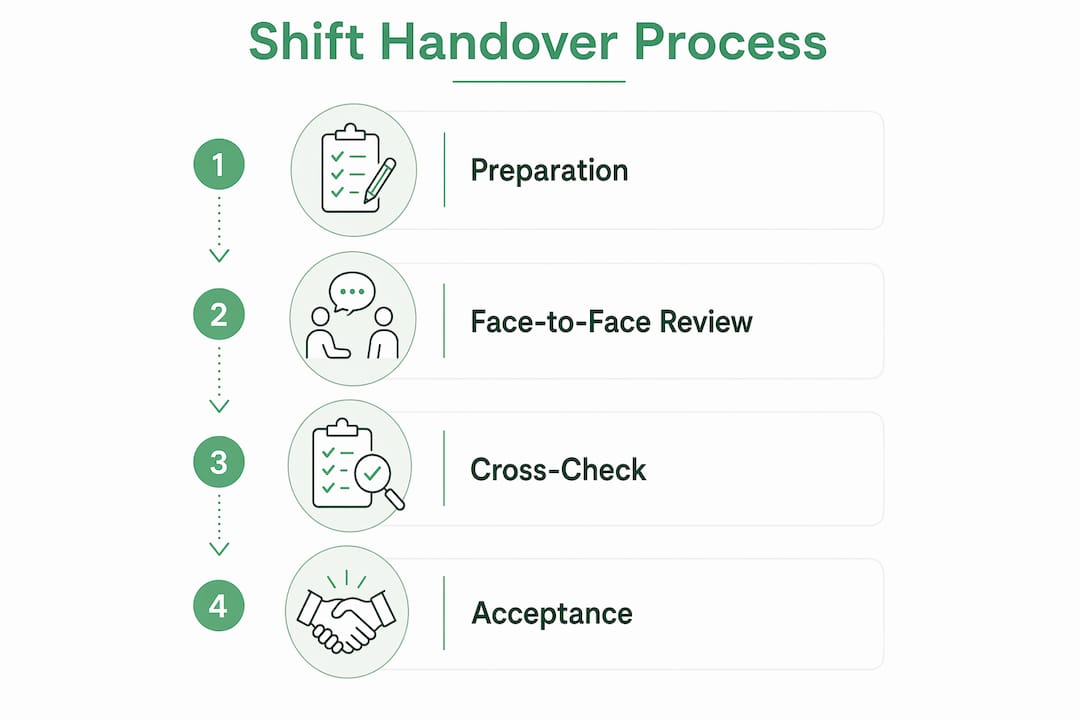
A repeatable shift change procedure has three phases. Each one has a specific owner and a specific output. Skip a phase and you create a gap the incoming team will fill with guesswork.
Phase 1: Preparation by the outgoing team
The outgoing team updates the shift log before the face-to-face review begins. This is not a summary of everything that happened. It is a status report: what is abnormal, what is still open, what the incoming team needs to act on, and where to find supporting evidence.
Every open item gets an owner, a next action, an expected timing, and any dependency that could block completion. Active permits get listed with their current status. Escalation thresholds get flagged explicitly, not buried in narrative. If a reading is outside normal range, attach the log. If a piece of equipment is isolated, note the isolation point.
Phase 2: Face-to-face two-way review
Face-to-face handovers at the work location significantly improve clarity because the outgoing team can point to physical anomalies and isolation points that a log entry cannot convey. Hold the briefing at the equipment or control station, not in a break room.

Use SBAR-style prompts to keep the conversation structured: Situation (what is the current state?), Background (what led here?), Assessment (what is the risk or priority?), Recommendation (what should the incoming team do first?). The incoming team asks questions. The outgoing team answers them. This is a two-way exchange, not a monologue.
Walk the floor when any open item involves physical equipment, an active permit, or a visible anomaly. A log entry that says "mixer running rough" means something different when you are standing next to the mixer.
Phase 3: Cross-check and acceptance by the incoming team
The incoming team verifies live conditions against the written record. They inspect any active permits. They confirm that the next actions and owners are clear. Then they sign acceptance with a timestamp.
Pro Tip: Sign-off does not mean every issue is resolved. It means the incoming team has reviewed the record, understands what is open, and now owns the work. Make that distinction explicit in your SOP so operators do not refuse to sign because something is still in progress.
What should every handover checklist include?
A structured handover focuses on the current state, open work, coming events, people, and first actions. It is not a chronological diary of the shift. The incoming team needs a usable view of where things stand right now, not a recap of everything that happened since 6 AM.
Here are the fields every handover checklist must capture:
State of the system
- Equipment status: running, down, isolated, or under maintenance
- Active permits to work (PTW), with permit numbers and expiry times
- Any abnormal operating conditions, alarms, or out-of-spec readings
- Staffing gaps or coverage changes for the incoming shift
Open work
- Each open item must include: named owner, next action, expected completion time, and any dependency
- Status labels alone ("in progress," "pending") are not enough. The next action must be obvious to someone who was not on the previous shift.
- Escalation threshold for each item: safety concern, quality hold, SLA breach, or customer commitment
Supporting evidence
- Attach logs, sensor readings, photos, or permit documents to each relevant item
- Do not reference evidence that is not attached. "See the log" is not a handover record.
Sign-off area
- Outgoing team member name, signature, and timestamp
- Incoming team member name, signature, and timestamp
- A visible field for exceptions noted at acceptance
Templates and SOPs that force mandatory fields, signature sign-offs, and escalation paths directly reduce the most common failure modes: the hallway handover, the asymmetric handover, and the assumed handover. Build the mandatory fields into the form so operators cannot submit an incomplete record.
How do digital tools change the handover versus paper?
Digital handover workflows can do things paper cannot: surface incomplete fields before submission, attach evidence automatically, timestamp every action, and retain a searchable audit trail. But they also introduce a specific failure risk that paper does not: the clean-looking digital report that hides an incomplete or unverified record.
Features your tool must have
A digital handover system needs structured forms with mandatory fields for exceptions, attachment capability for photos and logs, timestamped sign-off for both outgoing and incoming parties, and direct links to permits or work orders. Without mandatory fields, operators will skip the hard parts. Without timestamped sign-off, you have no audit trail.
Digital workflows can flag incomplete fields, attach evidence automatically, and retain an audit trail, but they must not replace human acceptance checks. That last point is the one most implementations get wrong.
Automation that actually helps
Useful automation includes missing-field checks that prevent submission of an incomplete record, auto-drafts that pull the previous shift's open items into the incoming view, notification routing that alerts the right supervisor when an escalation threshold is crossed, and audit-trail retention that lets you review any handover record weeks later. Gembalabs' AI-generated shift intelligence combines real-time equipment data with operator notes to produce exactly this kind of structured, searchable record.
The single-channel failure risk
Technology prepares and surfaces the record. It does not replace the incoming person's live verification for safety-critical items. An operator who reads a clean digital report and skips the floor walk has just created a single-channel handover. The tool should make the floor walk easier to document, not easier to skip.
For real-time equipment monitoring integrated with handover records, the incoming shift can see live equipment status during verification, which reduces the chance of accepting a record that no longer reflects actual conditions.
Why do handovers fail, and what actually fixes them?
Most handover failures fall into three categories. Each has a specific fix.
Single-channel handoffs. A verbal-only update or a written note that no one reads. The fix is mandatory written record plus face-to-face review plus sign-off. Remove any one of those three and you are back to a single channel.
Asymmetric or hallway handovers. Time pressure and end-of-shift fatigue push handovers into two-minute conversations at the door. The fix is a scheduled paid overlap treated as a formal work block in payroll and roster. Unpaid or after-clock handovers consistently degrade in quality because operators have no incentive to stay and no time to be thorough.
Logs treated as diaries. A shift log that reads "ran production all day, one minor issue with Line 3, resolved" tells the incoming team almost nothing. The fix is forcing the fields that matter: next action, owner, deadline, escalation threshold. Design the shift log as an actionable status report that highlights abnormal states and next actions, not a narrative recap.
A few more failure modes worth naming:
- Missing verification: incoming team signs off without checking live conditions. Fix: require a floor walk for any open permit or abnormal equipment state before sign-off is accepted.
- Assumed handover: outgoing team leaves without confirming the incoming team received and understood the record. Fix: two-party sign-off with timestamp, not just an outgoing signature.
- Multilingual gaps: in facilities with mixed English and Spanish-speaking operators, a handover record in only one language creates comprehension risk. Fix: bilingual forms or bilingual digital records. Gembalabs supports bilingual operator notes natively, which removes this gap for food manufacturers with mixed-language teams.
For industrial safety deployment, the same principle applies across the facility: a process that relies on a single person's memory or a single communication channel will eventually fail at the worst possible moment.
How do you measure whether your handovers are actually working?
Measuring handover effectiveness requires a small set of leading indicators and a regular audit routine. Trend analysis matters more than any single data point.
Suggested KPIs
| KPI | What it measures | Target |
|---|---|---|
| Mandatory field completion rate | Percent of handover records with all required fields filled | 95%+ per shift |
| On-time overlap compliance | Percent of handovers that start and end within the scheduled window | — |
| Unresolved escalations after handover | Open escalation items that were not assigned or actioned at handover | Trending toward zero |
| Audit compliance score | Percent of observed handovers that meet the full SOP | Baseline, then improve |
Audit routines
Auditing handovers through observed handovers and log reviews, then reporting compliance to site leadership, is a recognized best practice for continuous improvement. In practice, this means random observation of live handovers at least twice per month, periodic log reviews to check field quality and escalation handling, and cross-shift surveys that ask operators whether the records they received were clear and usable.
Interpreting the data
A single low score tells you something went wrong. A pattern of low scores in the same field tells you the form design or training is the problem. If the same open item appears unresolved across three consecutive handovers, that is a process gap, not a one-off miss. Use root cause analysis to investigate recurring unresolved items before they become incidents.
How do you roll out a new handover process without disrupting production?
A phased rollout reduces resistance and gives you real data before you commit to a facility-wide standard.
Pilot design and timeline
| Phase | Duration | Key activities |
|---|---|---|
| Pilot design | Week 1–2 | Select one line or area, define success criteria, brief supervisors |
| Live pilot | Weeks 3–10 | Run the new process, collect KPI data and operator feedback |
| Review and adjust | Week 11–12 | Analyze metrics, revise checklist fields, update training materials |
| Scale | Week 13+ | Roll out to additional lines with adjusted SOP and trained leads |
Choose a line with a motivated team lead and a mix of shift patterns. Set success criteria before you start: mandatory field completion rate, on-time overlap compliance, and a reduction in after-shift surprises reported by the incoming team.
Training
Short scenario-based sessions work better than slide decks. Run a 30-minute role-play for each shift team that covers a normal handover, a handover with an active PTW, and a handover during an unplanned event. Give operators a pocket card for the first 30 days that lists the mandatory fields and the escalation thresholds. For PTW sign-overs specifically, the role-play should require the incoming person to physically walk to the permit location and confirm conditions before signing.
Governance
Assign one person to audit handovers each week during the pilot. Corrective actions from audits go into a shared log with an owner and a due date. The acceptance rule for scaling: the pilot becomes standard operating practice when mandatory field completion holds above 95% for three consecutive weeks and the audit compliance score is stable.
PTW sign-overs, escalation design, and what the research says
Permit-to-work handovers are a separate event
PTW handovers must be treated as distinct, formal events where the incoming permit holder physically inspects the area and signs to accept responsibility. This is not a checkbox on the general handover form. It is a separate sign-over with its own record, its own timestamp, and its own physical inspection step.
The incoming permit holder walks to the work location, confirms the isolation is still in place, verifies the conditions match the permit, and signs acceptance. That record is timestamped and retained for audit. Any discrepancy between the permit conditions and the actual state of the equipment stops the handover until the discrepancy is resolved.
For food manufacturers, PTW requirements often intersect with food safety traceability obligations, making the timestamped audit trail doubly important.
Escalation thresholds need to be explicit
An escalation threshold is not "use your judgment." It is a named condition with a named contact and a response time. Your handover record should list at minimum: safety concern (immediate stop, contact supervisor), quality hold (notify QA lead within 15 minutes), SLA breach (notify operations manager before end of overlap), and equipment failure (contact maintenance, log isolation status).
Pro Tip: Print the escalation thresholds on the handover form itself, not in a separate SOP document. Operators under time pressure will not look up the SOP. They will use whatever is in front of them.
Gembalabs and the permanent digital record
The most reliable approach combines a permanent digital record for 24/7 access with mandatory live verification at handover. Gembalabs captures equipment cycle data and operator notes in a single record, generates AI-driven shift summaries, and surfaces open items for the incoming team automatically. That combination addresses the two most common failure modes: the missing written record and the missing verification step.
Key Takeaways
A structured shift handover process requires a scheduled paid overlap, a standardized checklist with mandatory sign-off, and a separate PTW verification event for safety-critical permits.
| Point | Details |
|---|---|
| Schedule the overlap as paid work | Lock an appropriately timed overlap into payroll and roster; unpaid handovers consistently degrade in quality. |
| Standardize the checklist | Every open item needs an owner, next action, deadline, and escalation threshold, not just a status label. |
| Treat PTW as a separate event | Incoming permit holders must physically inspect and sign acceptance before the outgoing team leaves. |
| Measure and audit regularly | Track mandatory field completion, on-time overlap compliance, and unresolved escalations; use trends to find process gaps. |
| Gembalabs digitizes the record | Gembalabs combines real-time equipment data with operator notes and AI-generated shift summaries to enforce structured handovers. |
Why structured handovers stick when leadership commits to them
The teams that sustain structured handovers long-term are not the ones with the best forms. They are the ones whose supervisors model the behavior. When a team lead shows up five minutes early, walks the floor with the outgoing operator, and signs the record in front of the crew, the message is clear: this is how we work here.
The cultural shift is from heroics to process. In a heroics culture, the experienced operator who "just knows" what is happening is the asset. In a process culture, the handover record is the asset, because it works even when that experienced operator is on vacation or has left the company. Structured handovers reduce after-shift surprises, speed up incident resolution, and create cleaner audit trails. Those are not abstract benefits. They show up in on-time delivery rates, rework costs, and the length of your next regulatory inspection.
Resistance usually comes from two places: operators who feel the form is bureaucratic, and supervisors who feel the overlap time is wasted. Both objections dissolve quickly when the team sees a single incident get resolved in ten minutes because the handover record had the right information, versus an hour of scrambling because it did not.
Gembalabs makes structured handovers easier to enforce and scale
Most food manufacturers already know what a good handover looks like. The gap is enforcement: mandatory fields get skipped, sign-offs happen after the fact, and the record lives in a notebook no one can search at 2 AM. Gembalabs closes that gap with structured digital handover forms, mandatory-field checks that block submission of incomplete records, evidence attachments, and timestamped sign-off for both outgoing and incoming operators.
The platform captures real-time equipment data alongside operator notes, then uses AI to generate shift summaries that surface open items, downtime events, and rework flags automatically. For facilities with mixed English and Spanish-speaking teams, bilingual operator notes are built in. PTW integration keeps permit sign-overs in the same record as the general handover, with a separate timestamped acceptance step. For small and medium-sized food manufacturers running two or three shifts, a pilot typically runs several weeks on a single line before scaling. To see how the shift intelligence features work in practice, request a demo and bring your current handover form. The Gembalabs team will show you exactly which fields map to mandatory checks and where the audit trail lives.
Useful sources and further reading
These references back the guidance in this article and are suitable for citing in your SOPs and training materials.
- HSE shift handover guidance: The UK Health and Safety Executive's shift handover page covers the three-phase model, two-way responsibility, and the principles behind effective handover design. Foundational for any SOP.
- Marsh Risk Engineering position paper: The Marsh position paper on shift handover provides recommended overlap durations, audit routines, and reporting expectations for industrial operations.
- SmartQHSE safety protocols guide: The SmartQHSE shift handover guide covers PTW-specific requirements, face-to-face location guidance, and safety-critical sign-over steps.
- Moxo practical workflow guide: The Moxo shift handover workflow covers digital features, checklist design, escalation path design, and the caution against replacing human verification with automation.
- MangoApps shift handover template: The MangoApps template is a practical starting point for mandatory-field design and SOP structure.
- Tommy shift handover guide: The Tommy handover guide covers the paid overlap principle, actionable log design, and common failure modes with practical fixes.