
For small and mid-sized U.S. food manufacturing facilities, the best digital logbook software is a sensor-integrated, manufacturing-specialist platform that natively combines industrial IoT monitoring, HACCP traceability, and AI-generated shift reports. Gembalabs is the recommended specialist option in this category. The decisive advantage: it captures both machine data (equipment cycles, run-time, anomalies) and human data (downtime causes, rework notes, operator observations) in one system, then surfaces that combined picture through AI-generated reports you can actually act on. The fastest way to verify fit is a focused two-week pilot on one or two production lines.
Table of Contents
- What should you look for in digital logbook software?
- How do sensors and AI actually change what a logbook does?
- What features and workflows does a production logbook need?
- How long does implementation take, and what does it cost?
- What does Gembalabs show in a real pilot?
- Key Takeaways
- The procurement mistake most operations teams make
- Gembalabs is built for exactly this problem
- Useful sources for vendor evaluation and compliance
What should you look for in digital logbook software?
Getting this decision wrong is expensive. A platform that looks good in a 45-minute demo often falls apart when a line operator is wearing gloves at 5:00 AM on a Sunday. Map your existing daily production and quality steps first, then use that map as a filter during every vendor demo.
Non-negotiable technical criteria:
- Industrial wireless support (915 MHz radio bands penetrate concrete and metal structures far better than consumer Bluetooth, which struggles with EMI from motors and compressors in real plant environments)
- Temperature, vibration, run-time cycle, and door/open-status sensor compatibility
- Data latency under 60 seconds for critical control points
- Tamper-evident, time-stamped records that cannot be edited after submission
- Bilingual operator input (English and Spanish) built into the UI, not bolted on
Operational fit criteria:
- Daily check flow completable in just a few minutes on a tablet or phone
- Configurable forms that mirror your existing paper workflow
- Role-based access so operators see only what they need
Regulatory and compliance criteria:
- HACCP/HARPC plan builder with CCP monitoring built in
- Batch traceability linked to every production record
- Audit-ready exports for SQF, BRCGS, FSSC 22000, and FSMA preventive controls
- Locked records with version history
Questions to ask every vendor during a demo:
- Which industrial sensor protocols do you support natively?
- What does your pilot program include, and who owns the data after it ends?
- What is your SLA for uptime, and how is support delivered for night shifts?
- Are setup and integration fees included or billed separately?
Red flags that should end the conversation: consumer Bluetooth-only sensors, no native batch traceability, a UI that requires more than two taps to log a deviation, or a vendor that insists you restructure your workflow to fit their software.
Platforms built for restaurants or hospitality typically lack manufacturing depth. Manufacturing-first platforms support industrial IoT protocols, recipe and batch management, and multi-shift traceability natively. That difference shows up immediately when you try to configure a HACCP plan.
Pro Tip: Score vendors on a weighted rubric: manufacturing fit (30%), sensor and IoT support (25%), compliance exports (20%), operator UX (15%), and total cost of ownership (10%). Run every demo against the same rubric and compare scores the same day.
How do sensors and AI actually change what a logbook does?
A paper logbook records what an operator noticed. A sensor-integrated digital logbook records what actually happened, whether anyone noticed or not.
Vibration and temperature sensors, combined with self-learning AI, establish baseline operating conditions for each piece of equipment and surface deviations automatically. That matters in food manufacturing because the gap between "running warm" and "failed bearing" is often measured in hours, not days. An alert at 2:00 AM catches a problem before the morning shift walks into a shutdown.
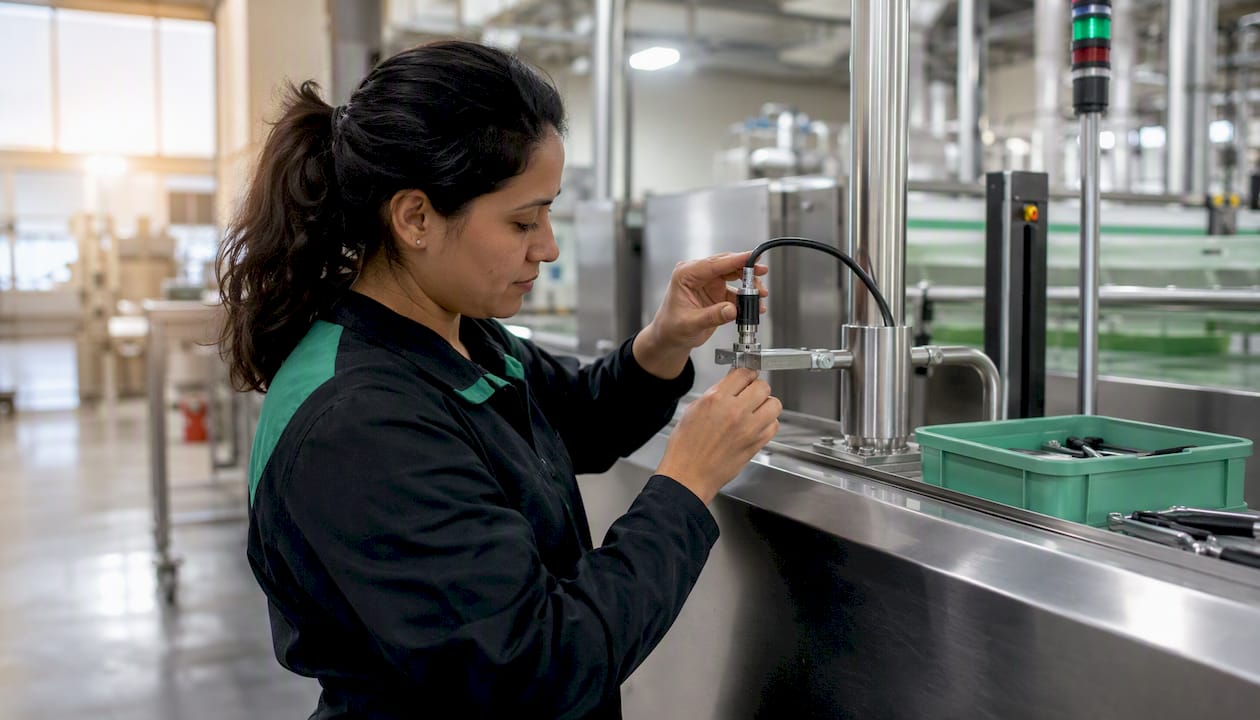
AI-driven monitoring also reduces the need for specialized vibration expertise by learning asset-specific baselines and flagging anomalies without manual configuration. For a 40-person plant without a dedicated reliability engineer, that is the practical difference between proactive maintenance and reactive repair.
Cloud infrastructure and wireless sensors remove the need for on-premises servers and cut cabling costs, making real-time equipment monitoring genuinely practical for SMB plants. Deployment that once required weeks of IT work now typically runs much faster, often within days.
What features and workflows does a production logbook need?
A feature list only tells you what a platform can do. The operator workflow tells you whether anyone will actually use it.
Core feature checklist:
- HACCP/HARPC plan builder with CCP step monitoring
- Batch linking: every log entry tied to a lot or batch number
- Operator notes with photo and voice attachment
- Tamper-evident timestamps on every record
- Bilingual UI (English/Spanish) switchable per user
- Role-based access (operator, supervisor, quality, admin)
- Audit-ready exports in PDF and CSV
- API or native integrations with ERP and traceability systems
- Offline capture that syncs when connectivity returns
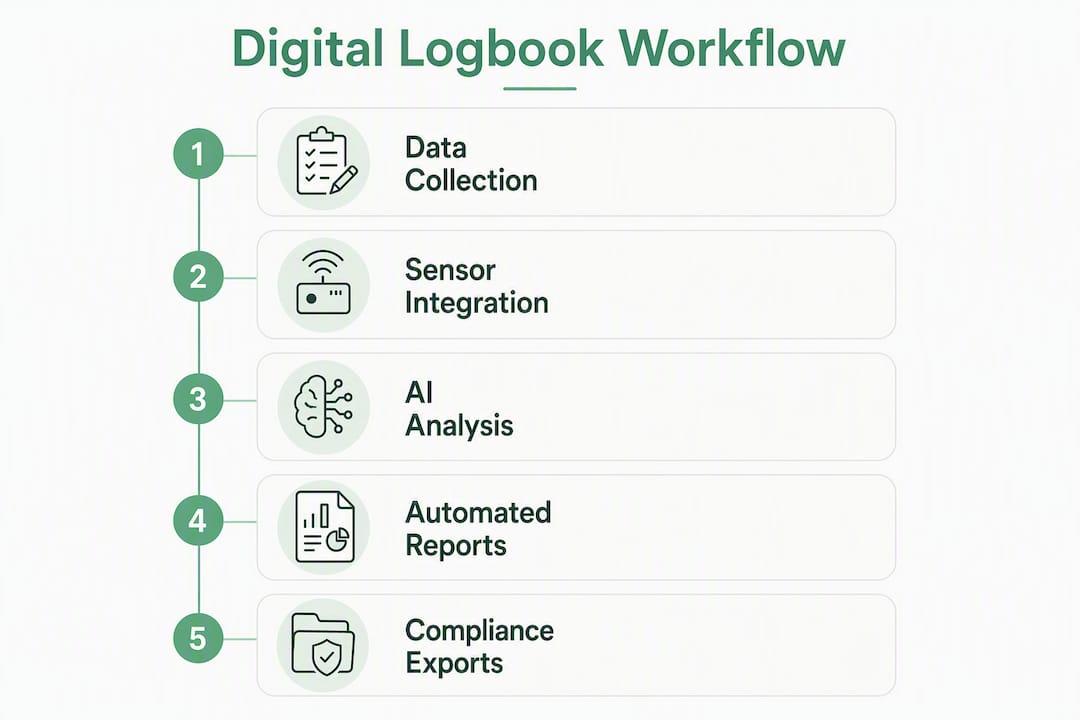
A typical operator workflow looks like this:
- Start-of-shift: open the app, confirm assigned line and batch number
- Sensor verification: the system auto-confirms sensor readings; operator reviews any pre-shift alerts
- Exception capture: log a deviation with a photo or short voice note; assign a corrective action to the responsible person
- Mid-shift checks: 2–3 taps per CCP; the system timestamps and locks each entry
- End-of-shift: review the AI-generated shift summary, add any handover notes, submit
That last step is where a sensor-integrated logbook separates itself. The shift handover report is generated automatically from sensor data and operator entries, not typed from memory. A supervisor reviewing the night shift at 6:00 AM gets a factual summary, not a narrative.
UX requirements for shop-floor use are non-negotiable. Large touch targets, fast load times, and one-hand entry keep daily checks under five minutes. If the interface requires two hands and a stylus, adoption collapses within two weeks.
How long does implementation take, and what does it cost?
A realistic pilot-to-production timeline for a single line at a small food plant typically runs several weeks.
| Phase | Owner | Duration |
|---|---|---|
| Workflow mapping and sensor placement planning | Operations lead + vendor | Week 1 |
| Sensor installation and system configuration | Maintenance + vendor tech | Week 1–2 |
| Live data collection and operator training | Operations lead + line operators | Weeks 2–3 |
| Pilot evaluation against success metrics | Operations + quality leads | Week 4 |
| Decision and scale-out planning | Plant owner + IT | Week 5–6 |
Cost drivers to clarify before signing anything:
- Number of sensors and sensor types required
- Integration complexity (ERP, traceability platform, cloud storage)
- Pilot support level: self-serve setup vs. vendor-managed onboarding
- Data retention requirements (90 days vs. 3 years for FSMA)
Pilot success metrics worth tracking from day one:
- Reduction in missed CCP checks per shift
- Anomaly detection lead time (how many hours before failure did the alert fire?)
- Downtime incidents identified vs. incidents that caused unplanned stops
- Operator adoption rate by end of week two
A two-week pilot with real production data across multiple shifts catches problems a demo never will: concurrent users, night-shift behavior, and the edge cases your paper forms handle by habit.
What does Gembalabs show in a real pilot?
Gembalabs tracks both equipment performance and staff input, combining sensor-captured machine data with operator-entered downtime causes, rework notes, and batch records. That combination is what makes the AI-generated reports useful rather than decorative.
Pilot outcomes Gembalabs reports from client deployments:
- Faster identification of recurring downtime causes, with root-cause patterns surfacing within the first week of data collection
- Reduction in missed or late CCP checks as automated sensor alerts replace manual reminder systems
- Shorter shift handovers because supervisors receive a structured AI-generated summary rather than a verbal briefing
What an AI-generated shift report from Gembalabs includes:
- Equipment cycle counts and utilization by line
- Anomalies flagged during the shift with timestamps and sensor readings
- Downtime events logged by operators, categorized by cause
- Rework quantities and associated batch numbers
- Open corrective actions carried forward to the next shift
Operators consistently report that the daily check flow is faster than paper once the first week of habit-building is done. The equipment performance data becomes actionable within days, not months, because the AI learns your equipment's normal operating range from actual production cycles rather than manufacturer specs.
Key Takeaways
Sensor-integrated, manufacturing-specialist digital logbooks outperform generalist checklist apps for U.S. food manufacturers because they combine industrial IoT monitoring, HACCP traceability, and AI-generated shift reports in one system.
| Point | Details |
|---|---|
| Prioritize industrial wireless | 915 MHz sensors outperform Bluetooth in metal-heavy, EMI-rich food plant environments. |
| Map workflows before demos | Use your existing daily production steps as a non-negotiable filter during every vendor evaluation. |
| Run a two-week pilot | A focused pilot on one or two lines catches night-shift and concurrent-user issues a demo never reveals. |
| Track four pilot metrics | Measure missed CCP checks, anomaly lead time, downtime incidents, and operator adoption rate. |
| Gembalabs as specialist option | Gembalabs combines equipment cycle data, operator notes, and AI-generated shift reports in one platform built for SMB food plants. |
The procurement mistake most operations teams make
Most teams spend 80% of their evaluation time on feature checklists and 20% on actual usability. That ratio should be reversed.
A platform that centralizes HACCP, corrective actions, and audit evidence is only as good as the rate at which operators actually log data. A missed entry at 3:00 AM is a compliance gap, regardless of how many features the software has. The audit-framework fit matters too: software must produce the evidence your auditor expects for your specific certification, whether that is SQF, BRCGS, or FSMA preventive controls. Verify this with a sample export before you commit.
Be cautious with vendors who bundle extensive consulting packages into the pilot. If you have an operations lead who understands your workflow, you do not need a six-week implementation engagement. A well-designed platform should be configurable by your team in days. And if a vendor tells you that you need to change how your line runs to fit their software, that is the wrong vendor.
Gembalabs is built for exactly this problem
Small and mid-sized food plants do not need enterprise-scale complexity. They need a system that captures what sensors see and what operators know, then turns both into a report someone can act on before the next shift starts.
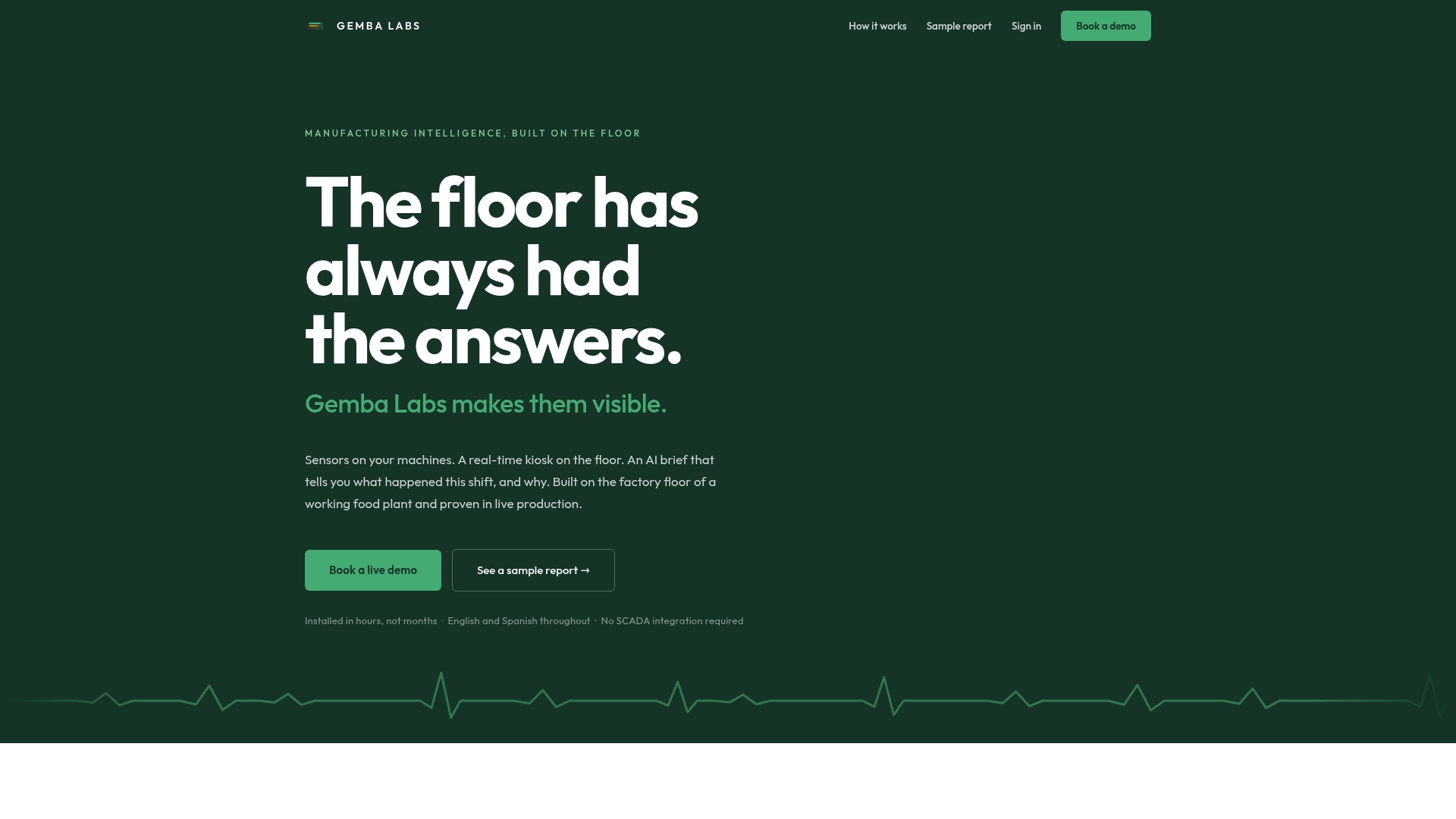
Gembalabs connects directly to your equipment sensors, collects operator input on downtime, rework, and batch events, and generates AI-driven production intelligence reports on the specific KPIs you care about. No generic dashboards. No six-month implementation. A two-week pilot on one line, with your actual production data, is enough to see whether the system fits.
See how it works and schedule a pilot at Gembalabs product intelligence.
Useful sources for vendor evaluation and compliance
When validating vendor claims during an audit or certification review, these U.S.-focused resources are worth bookmarking:
- Intelligent Sensors for Sustainable Food and Drink Manufacturing — Frontiers in Sustainable Food Systems: peer-reviewed coverage of sensor types and machine learning applications in food production
- FSMA 204 Traceability: Your 2026 Compliance Guide — current FSMA 204 traceability requirements and what your logbook software must capture
- Best Food Traceability Software for SMB Plant Managers — practical guidance on traceability platforms that integrate with production logbooks
- Food Safety Compliance Software: Complete Guide — covers HACCP, corrective actions, and audit-evidence requirements across major certifications
Compliance checklist: verify these with every vendor before signing:
- Audit-ready exports in the format your certifying body requires (PDF, CSV, or direct portal upload)
- Locked, tamper-evident records with full version history
- Batch-level traceability linked to every production log entry
- Data residency confirmed as U.S.-based servers (relevant for FSMA and state-level food safety regulations)
- Documented SLA for uptime and support response time during production hours