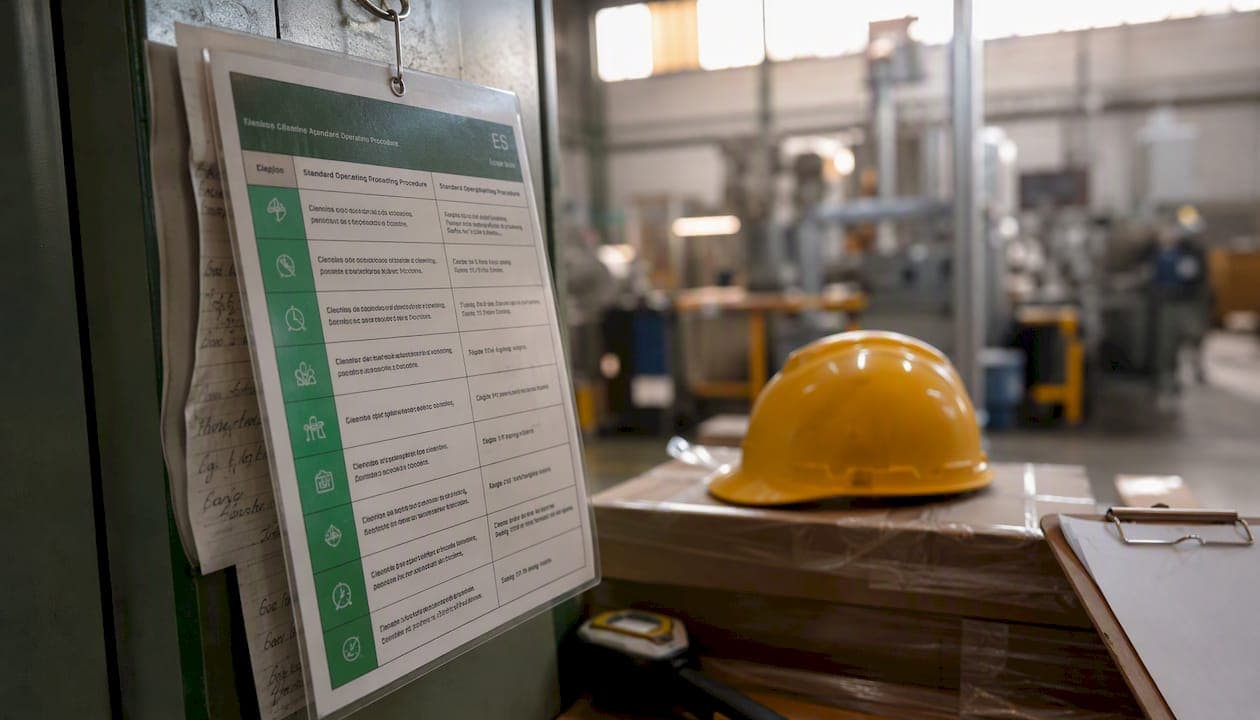
Download a vetted Spanish SOP template, assign a subject-matter lead, and run a one-to-two shift operator walkthrough before you post anything on the line. That's the short version. For a U.S. food plant where a significant portion of your crew reads Spanish as a first language, a translated procedure isn't a courtesy — it's a compliance and safety necessity. Three resources give you a running start today: UC SAREP's Spanish-language SOP PDFs for cooler storage and hygiene tasks, the MSU Extension Spanish SOP pack for farms and processing operations, and Cornell CALS bilingual food-safety resources that pair training context with ready-to-adapt templates. Download one, adapt it to your site, validate it on the floor, and you have a working document by end of week.
Key Takeaways
Spanish SOPs for food manufacturing work best when vetted templates are adapted on-site, validated by operators on the floor, and connected to live equipment data for continuous monitoring.
| Point | Details |
|---|---|
| Download vetted templates first | Use UC SAREP, MSU Extension, or the Food Safety Clearinghouse as your starting point before writing from scratch. |
| Run operator validation shifts | A one-to-two shift dry run with operator sign-off catches SOP gaps before they become audit findings. |
| Keep bilingual version control tight | Assign one document ID to both language versions and update them together to prevent drift. |
| Integrate SOPs with digital systems | Link SOP steps to sensor thresholds so deviations trigger alerts automatically rather than relying on manual checks. |
| Treat AI drafts as starting points | Any AI-generated SOP requires bilingual SME review and a live validation shift before deployment. |
Table of Contents
- Where can you download Spanish SOP templates for manufacturing?
- What is an SOP in manufacturing, and what must it include?
- How do you write a manufacturing SOP step by step?
- How do you translate SOPs into Spanish accurately?
- How do you get frontline operators to actually use Spanish SOPs?
- How do you digitalize Spanish SOPs and use AI safely?
- What do U.S. auditors check for in translated food manufacturing SOPs?
- Sources
Where can you download Spanish SOP templates for manufacturing?
The Food Safety Resource Clearinghouse is the single best starting point. It aggregates UC SAREP and UC Davis sample SOPs covering hygiene, cooler storage, facility cleaning, pest control, and sanitizing solutions — all available in Spanish, with blank bilingual templates you can fill in for your site. These are free, education-licensed documents designed for small-scale food operations, which means they map well to the scale and complexity of most U.S. food SMEs.
Beyond the Clearinghouse, here's where to look and what each source gives you:
- UC SAREP (UC Davis): Individual Spanish PDF SOPs for cooler storage and temperature monitoring, facility cleaning, allergen control, and chlorine sanitizing solutions. Each is task-level and structured for line-side use.
- MSU Extension: Translated SOP templates aimed at supporting Spanish-speaking staff on farms and in processing facilities. Local adaptation is required before deployment.
- Cornell CALS: Bilingual Spanish-English food-safety introductions and training resources. Less template-heavy, more context-rich — useful for aligning your SOPs with common U.S. food-safety expectations.
- SQF-aligned commercial bundles: Vendors such as Sirocco Consulting sell SQF Edition 9.0 SOP template bundles in English and Spanish. These cost money and still require site-specific adaptation, but they're worth considering if your facility is pursuing SQF certification.
Before you download and deploy, run through this short checklist:
- Does the template cover a food or non-food process? (UC SAREP templates are food-specific; some generic manufacturing SOPs won't map to FDA/USDA recordkeeping requirements.)
- Is it bilingual in a single document, or are English and Spanish in separate files? Single-document bilingual layouts are easier to version-control.
- What are the license terms? UC SAREP and MSU Extension materials are educational and freely adaptable. Commercial bundles have restrictions.
- Does it include a revision history block and signature fields? If not, add them before you use it.
Adapting any template for your U.S. facility means confirming that measurement units, recordkeeping fields, and critical control point language align with your FDA or USDA program. A template built for a California food hub may need adjustments for a Midwest meat processor.
What is an SOP in manufacturing, and what must it include?
A standard operating procedure (SOP) is a written, step-by-step instruction that tells a specific person how to complete a specific task to a defined standard — covering who does it, what they use, when it happens, how each step is performed, and what "done correctly" looks like. In Spanish-language manufacturing contexts, you'll see two terms: Procedimiento Operativo Estándar (POE) is the common translation used in food, agriculture, and general manufacturing. Procedimiento Normalizado de Trabajo (PNT) appears more often in pharmaceutical and laboratory settings. For a U.S. food plant, POE is the right default.
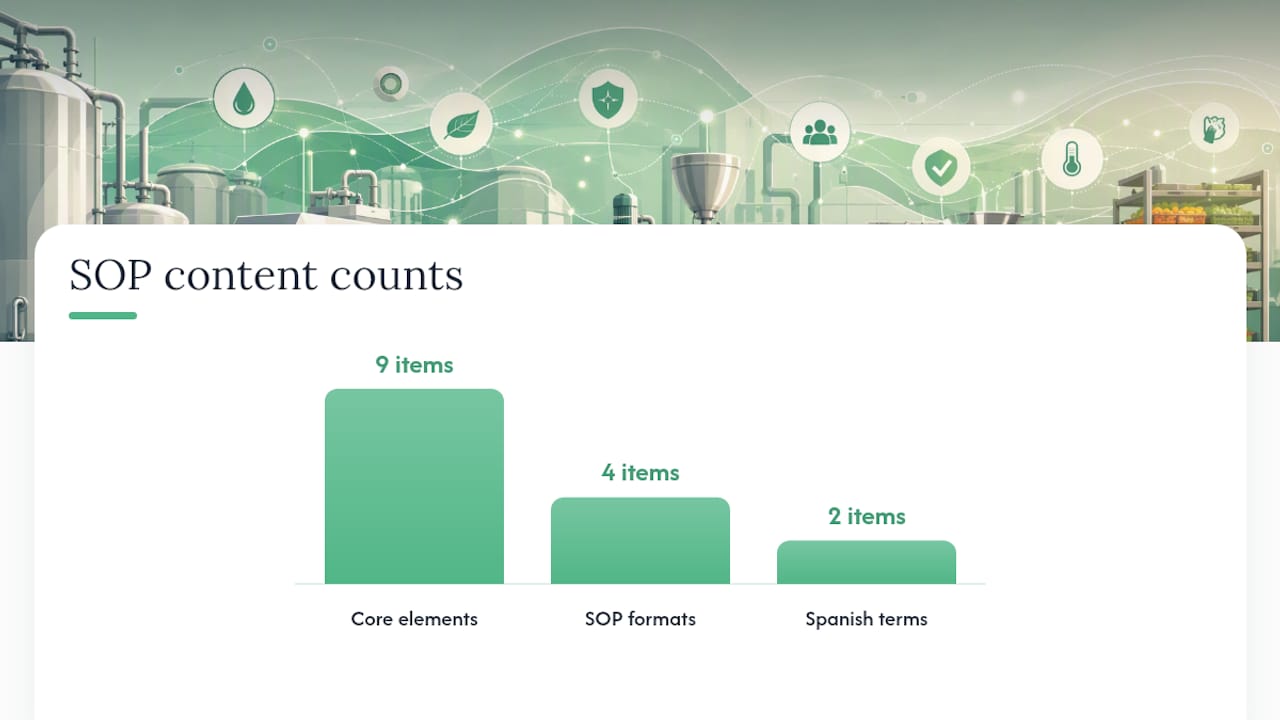
Every manufacturing SOP needs these core elements:
| Element | What it contains |
|---|---|
| Title and document ID | Unique name and version number for tracking |
| Purpose | One sentence on why this procedure exists |
| Scope | Which products, lines, shifts, or locations it covers |
| Responsibilities | Who performs, who supervises, who approves |
| Materials and tools | Equipment, chemicals, PPE, measuring instruments |
| Step-by-step procedure | Numbered, single-action steps with measurable criteria |
| Safety and compliance notes | Hazards, regulatory references, required PPE |
| Acceptance criteria | What a passing result looks like (temperature, visual check, etc.) |
| Revision history | Date, version, change summary, approver signature |
SOP format options and when to use each:
| Format | Best for | Limitation |
|---|---|---|
| Step-by-step numbered list | Linear tasks with a fixed sequence | Harder to follow for branching decisions |
| Hierarchical (sections + sub-steps) | Complex multi-phase procedures | Can become too long for line-side use |
| Flowchart | Decision-heavy processes | Requires translation of visual labels too |
| Checklist | Inspection or verification tasks | Lacks detail for training new staff |
For most food plant floor tasks, a numbered step-by-step format fits best. Reserve flowcharts for processes where the operator must make a yes/no decision at multiple points.
How do you write a manufacturing SOP step by step?
The authoring sequence below works for a new SOP or a site adaptation of a downloaded template. Keep the process tight — a SOP that takes three months to write is usually one that nobody validated on the floor.
- Define the objective and scope. Write one sentence: what task does this SOP govern, on which line or area, and during which shifts? Narrow scope beats vague scope every time.
- Identify your subject-matter expert (SME) and author. The SME is the person who actually does the task. The author writes it down. They can be the same person, but the SME must be involved.
- Observe the actual process. Watch the task performed at least twice. Record timestamps, tool names, and any informal checks operators already do. Sensor data or equipment logs are useful here — they give you real durations and measurable thresholds, not guesses.
- Draft the steps. Write each step as a single-action sentence with a specific verb: "Set cooler thermostat to 35°F." "Record temperature on log sheet." Avoid compound steps that bundle two actions.
- Add acceptance criteria. For each critical step, state what a correct result looks like: a temperature range, a visual indicator, a weight, a time window.
- Include safety notes and regulatory references. Flag any PPE requirements, chemical handling rules, or FDA/USDA recordkeeping obligations.
- Build the revision history block. Version 1.0, date, author, approver. Leave rows for future revisions.
- Secure approvals. Get signatures from the SME, the supervisor, and — for critical control points — a quality or food-safety lead.
One-page line-side template structure (fits on a single sheet, laminated):
| Field | Content |
|---|---|
| Title / Doc ID | e.g., "Cooler Temp Check — SOP-COOL-001 v1.0" |
| Purpose | One sentence |
| Steps | Numbered 1–8 (or fewer) |
| Acceptance criteria | Pass/fail indicators per step |
| Deviations | "If temp exceeds 41°F, notify supervisor immediately" |
| Signatures | Operator, supervisor, date |
| Version | v1.0 — [date] |
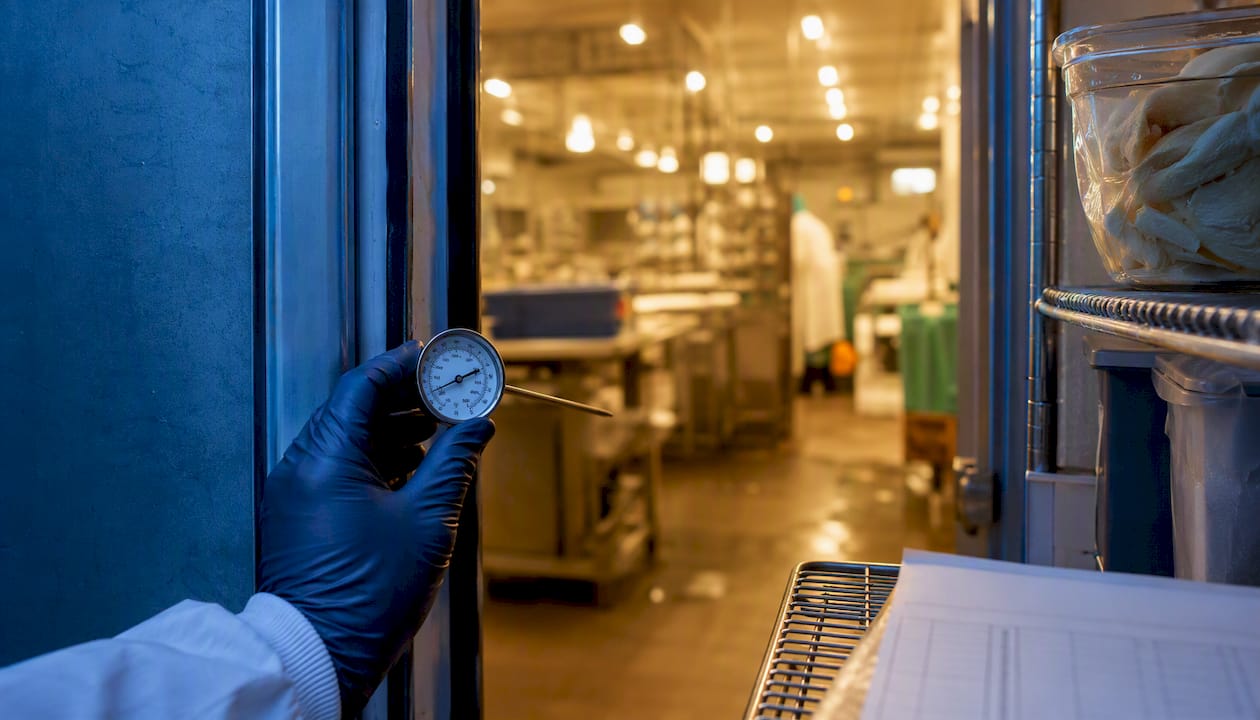
Mapping a real example: A cooler storage temperature check SOP maps cleanly to this format. Step 1: open cooler door and read the thermometer. Step 2: record temperature on the daily log. Step 3: if temperature is above 41°F, remove product and notify the shift supervisor. Acceptance criterion: temperature between 32°F and 41°F. Deviation action: escalate and log. That's the whole procedure on one page.
Pro Tip: Run a one-to-two shift dry run with the operators who will actually use the SOP. Have them sign the run record and note any step that caused confusion or didn't match what they actually do. Edit immediately. An SOP that survives two real shifts without a deviation note is ready to post.
How do you translate SOPs into Spanish accurately?
Translation is where most facilities lose time and introduce risk. A literal word-for-word translation of an English SOP often produces phrasing that's grammatically correct but operationally confusing — especially for action verbs and measurement terms.
Core translation rules:
- Use plain, action-oriented language. "Verifique la temperatura" beats "Proceda a efectuar la verificación de la temperatura."
- Keep terminology consistent across every SOP in your facility. If you call a cooler a cámara frigorífica in one document, don't call it a refrigerador in another.
- Validate with bilingual operators before posting. Run the translated SOP with at least two bilingual operators and one monolingual Spanish speaker on a live task. If the monolingual operator can follow it without asking questions, it's ready.
- Mark regulatory terms for legal review. Phrases tied to critical control points, corrective actions, or HACCP language should be reviewed by someone with food-safety regulatory knowledge, not just a general translator.
Mini bilingual glossary for food manufacturing SOPs:
Compact Spanish SOP mini-template (header block):
Título / ID: [Nombre del procedimiento — SOP-XXX-001 v1.0] Propósito: [Una oración] Alcance: [Línea, turno, área] Responsabilidades: [Operador, supervisor] Materiales: [Lista] Pasos: [Numerados] Criterios de aceptación: [Por paso crítico] Historial de revisiones: [Versión, fecha, aprobador]
Version control between English and Spanish copies is where drift happens. The safest approach: assign a single document ID (e.g., SOP-COOL-001) and maintain both language versions under that ID, updated together every time a revision is made. Separate IDs for the Spanish and English versions almost always diverge within six months.
How do you get frontline operators to actually use Spanish SOPs?
Writing a good SOP is half the job. Getting it used daily is the other half. Procedures that live in a binder on the supervisor's desk — written for auditors, ignored by operators — are called shelf-ware, and they're a liability, not an asset.
Adoption comes down to a few concrete practices:
- Involve operators in authoring sessions. When the person who does the task helps write the procedure, they recognize it as accurate and feel ownership over it. This is the single highest-leverage adoption tactic.
- Post one-page visual job aids at the point of use. Laminated, line-side copies in Spanish. If the operator has to walk to a binder, they won't check it mid-task.
- Keep initial training short. A 15-to-30-minute walkthrough of a new SOP is enough for an experienced operator. Longer sessions signal that the procedure is too complex.
- Run supervisor spot checks in the first two weeks. Not to catch mistakes — to catch SOP gaps. If an operator is doing something the SOP doesn't cover, the SOP needs updating.
- Set a revision cadence. Review every active SOP at least annually, or after any process change, equipment swap, or corrective action that touches the procedure.
Metrics worth tracking after deployment:
- Compliance checks completed vs. scheduled (are operators signing the log?)
- Deviations logged per shift (a high deviation rate early on usually means the SOP needs editing, not that operators are failing)
- Time-to-complete vs. the standard time in the SOP
- First-pass yield on the line or task the SOP governs
Pro Tip: After the first two shifts on a new Spanish SOP, hold a five-minute debrief with the operators who ran it. Ask one question: "Was there anything in the procedure that didn't match what you actually did?" Write down every answer. Those answers are your revision list.
How do you digitalize Spanish SOPs and use AI safely?
Digital SOPs are most useful when they're connected to live equipment data. When a sensor reading crosses a threshold — say, a cooler temperature above 41°F — a linked digital SOP can trigger an automatic alert or work order, so the operator doesn't have to catch the deviation manually. Gembalabs does exactly this: it pulls real-time equipment data alongside operator inputs to surface deviations and generate AI-driven production reports, so your SOP compliance and your equipment performance live in the same system. See how it works.
On AI-drafted SOPs: Tools like ChatGPT can generate a plausible SOP outline or translate phrasing in seconds. Use them as a first draft, not a final document. An AI-generated SOP has not been observed on your floor, does not know your equipment's actual cycle times, and cannot validate that its Spanish phrasing is operationally clear to your crew. Every AI draft requires review by a bilingual subject-matter expert and a live validation shift before it goes on the line. Treat it the way you'd treat a template downloaded from the internet: a starting point that still needs your site's specifics.
Digital system checklist for SOP management:
- Bilingual content support (can the system display Spanish and English in the same document view?)
- Version control with approver signatures and audit logs
- Mobile or tablet access at the line — operators shouldn't need a desktop to pull up a procedure
- Integration with your CMMS or MES so deviations auto-generate work orders
- Role-based permissions so operators can view and sign, but only authorized users can edit
For a practical look at how sensor-first monitoring connects to equipment performance metrics that your SOPs should be tracking, that guide covers the KPIs worth building into your acceptance criteria.
Pro Tip: Assign a single document ID to each SOP and link both the English and Spanish versions under it in your digital system. When you update one, update both simultaneously. Separate IDs for each language version will drift apart within a few revision cycles, and an auditor will notice.
What do U.S. auditors check for in translated food manufacturing SOPs?
FDA and USDA auditors don't grade your Spanish. They check whether your documented procedures accurately reflect what actually happens on the floor, whether records are complete, and whether your revision history shows that the document is maintained. A translated SOP that describes a process you no longer use is a nonconformity regardless of how well it's written.
Here's what auditors typically want to see:
- Signed operator logs for every SOP-governed activity — date, operator name, result, and any deviation noted.
- Version history with approver signatures — who approved each version, when, and what changed. A document with no revision history looks like it was written for the audit, not for the operation.
- Training records showing that every operator using the SOP was trained on the current version. If you updated the SOP in March and an operator was trained in January, you need a record of the refresher.
- Corrective action logs for any deviation from the SOP — what happened, what was done, and whether the SOP was updated as a result.
- Accuracy of translation at critical control points. If a CCP step is mistranslated and an operator follows the Spanish version incorrectly, that's a food-safety failure, not just a language issue.
Translated SOPs used in critical control activities — temperature control, allergen handling, sanitation — should be validated by a bilingual SME with food-safety knowledge, and legal or regulatory review is worth the investment for any CCP document. A poorly translated CCP SOP is a liability, not just a compliance gap. For shift handover procedures specifically, version awareness across shifts is a recurring audit finding — make sure the current version number is visible on every posted copy.
What actually works in plants — and what doesn't
The most common mistake I see in Spanish SOP programs isn't a translation error. It's a process error: the SOP was written at a desk, reviewed by a manager, and posted on the line without a single operator ever walking through it before it went live. The procedure looks right on paper because it was written by someone who knows the process conceptually. But the operator who actually does the task knows three things the manager doesn't: which step takes twice as long as written, which tool is never where the SOP says it should be, and which acceptance criterion is impossible to check without a second person.
One-page job aids in Spanish, written with the operators who use them, beat a ten-page bilingual binder every time. The binder is for the auditor. The job aid is for the person doing the work at 6 AM.
Gembalabs takes this a step further by connecting SOP-governed steps to live sensor data — so when a cooler temperature drifts or a line cycle runs long, the system flags it before the shift supervisor catches it manually. That's the difference between a procedure that lives on paper and one that's embedded in how the facility actually runs.
Sources
- Food Safety Resources for Food Hubs - Sample Standard Operating Procedures (SOPs) | Food Safety Resource Clearinghouse
- Sarep
- Cals